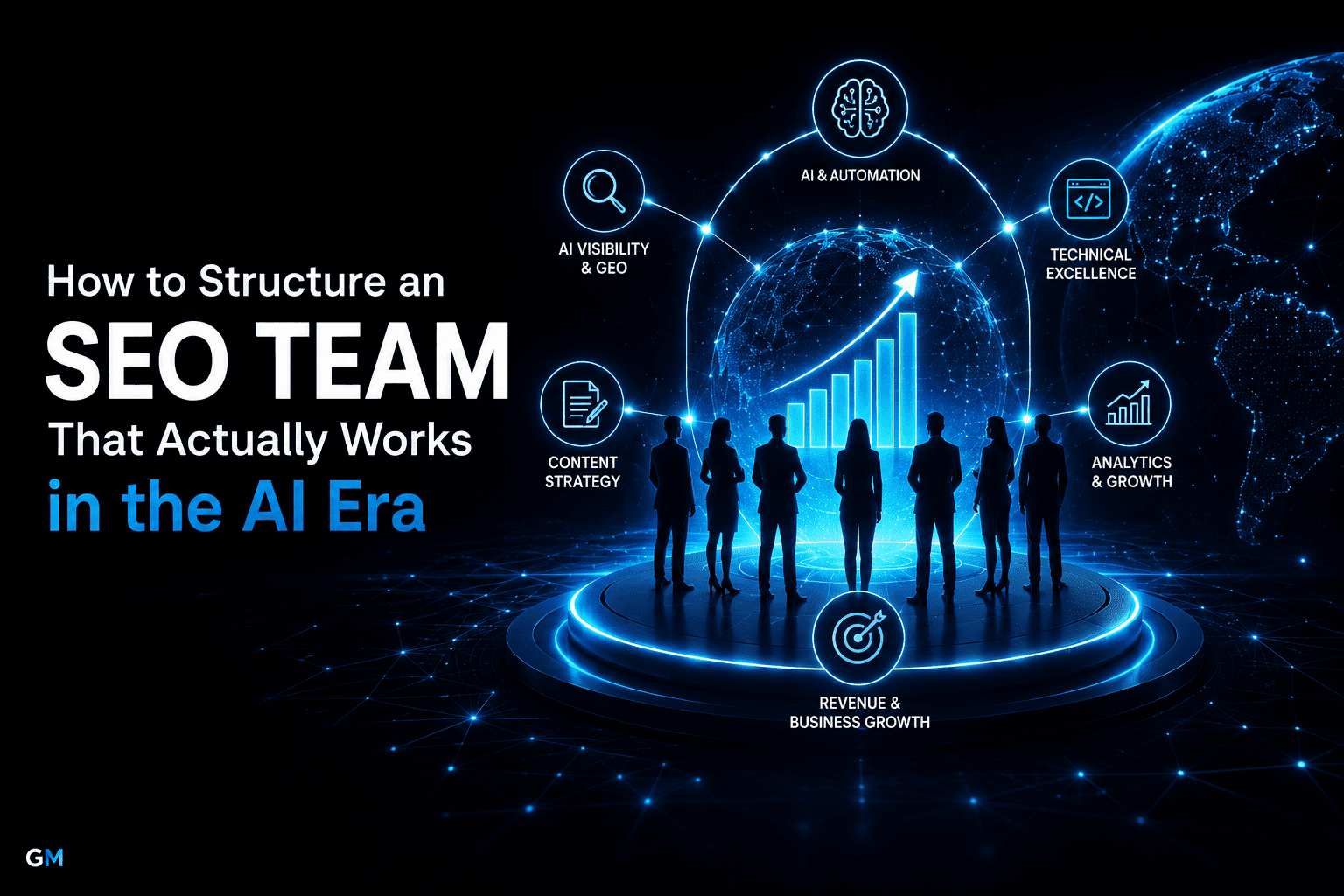
Most SEO teams inherit a structure: a lead, writers, maybe a technical specialist, and a dashboard full of rankings. That can work, but it is not a reason to hire the same roles in the same order at every company. Start with the business question. What must search help the company do, and what work is actually stuck?
My view comes from working across SEO, content, analytics, and growth, then building tools to test how much of the routine work can be improved. It is a proposed operating model, not evidence that any one team shape outperforms another.
Semrush analyzed 3,900 US SEO job listings captured in November 2025. Its sample shows demand for project management, analytics, experimentation, and AI literacy alongside search fundamentals. Job listings tell us what employers ask for. They do not tell us the ideal number of people on a team or prove that a dedicated AI role improves results.
What changed for SEO teams between 2018 and 2026
The work now spans more surfaces and more decisions. Traditional search still matters. Google’s AI features and other answer tools add questions about where a brand appears, what sources get cited, and whether that visibility brings qualified demand. Google’s guidance for its AI search features still starts with useful content and a good experience for visitors.
AI can help draft briefs, summarize crawl data, classify queries, and find patterns. Someone still has to check the input, the output, and the business decision. A faster report about the wrong KPI is still the wrong report.
The team therefore needs a mix of search craft, editorial judgment, technical access, and measurement. Those are capabilities. They do not always need separate job titles.
The capabilities a modern SEO team needs
Search lead. Owns priorities and explains tradeoffs to product, engineering, content, and leadership. This person connects the search roadmap to a business goal and decides what gets done first.
Technical SEO. Works on architecture, rendering, performance, crawling, indexing, and implementation with developers. The need depends on the site: a large JavaScript-heavy product has a different bottleneck from a small editorial site.
Content strategy and editorial work. Understands customer questions, decides what is worth publishing, and checks whether the answer is useful and accurate. AI can assist a draft; it cannot be accountable for the claim.
Measurement. Defines meaningful events and connects search work to qualified leads, revenue, or another outcome the business can actually observe. This capability may live with a growth or analytics team. My SEO KPI framework goes deeper on that decision.
Automation. Removes repetitive work when the workflow is stable enough to test. A specialist may be useful if the team has several recurring pipelines. For a smaller team, a lead or analyst with good tooling may be enough. I use this decision framework before proposing an agent.
AI search research. Tracks relevant answer surfaces, checks the limits of citation and prompt data, and asks whether visibility changes a buyer’s decision. It belongs in the plan when the audience uses those surfaces. It is not an automatic first hire or a standalone growth strategy.
Team size by company stage
Revenue alone is a poor staffing calculator. Look at site complexity, content volume, product release speed, language and region coverage, the size of the opportunity, and how much support already exists in engineering, analytics, and editorial.
- One owner: give the person clear priorities and access to specialists or contractors for work they cannot do well alone.
- Growing function: add the capability that is blocking the roadmap. If shipping technical fixes takes months, solve the engineering handoff. If no one knows which content matters, add editorial strategy. If reports cannot distinguish leads from noise, fix measurement.
- Established team: split roles when the work volume and coordination cost justify it, then review the structure as the business changes.
The illustration in the earlier version of this article compared old and proposed role mixes. Treat it as a sketch of possible responsibilities, not a measured industry staffing pattern.
The growth mindset: why SEO teams think beyond rankings
Rankings, impressions, and crawl findings help diagnose the work. They do not answer whether it moved the business. Choose a small number of outcomes that matter for this company, then keep the channel metrics as supporting evidence.
That also means planning with paid, lifecycle, product, and brand. A branded search increase may reflect work outside SEO. A lead may discover the company through search and convert later through another channel. Report that path honestly instead of claiming all the credit.
How to hire in the right order
Write down the next two quarters of work before writing a job description. Which decisions are unowned? Which tasks recur? Which bottleneck costs the business most?
- Choose an accountable owner. If search is a serious bet, someone needs to make priorities, coordinate implementation, and explain the result.
- Fix the largest bottleneck. Hire or contract for technical SEO, content, analytics, or automation based on the work that is stuck. Do not assume the second hire must have AI in the title.
- Review the handoffs. A new specialist helps only if they can access the data, people, and systems needed to ship.
- Add AI search depth when it earns a place. First establish the audience question and a measurement method. Then decide whether the work requires a dedicated person.
I would rather see a small team with clear ownership and working handoffs than a larger team built from fashionable titles.
Final thoughts
The useful question is not “How many people should a 2026 SEO team have?” It is “Which capability is missing from the work we have decided matters?” Answer that, hire for the gap, and change the structure when the evidence changes.
Find me on LinkedIn if you are building a team and want to compare where the bottleneck really is.
FAQ
Does every SEO team need an AI specialist?
No. First identify a repeatable workflow, a quality check, and an owner. If several important workflows need ongoing engineering and evaluation, a specialist may make sense. Otherwise, train the existing team and use tools selectively.
What is the right SEO team size for a $50M ARR company?
ARR does not provide a reliable headcount target by itself. The answer depends on the site, markets, product cadence, content program, and support from other teams. Scope the work and its bottlenecks before choosing a number.
Should I hire a writer or an automation specialist first?
Hire for the constraint. If you have valuable customer questions and no one to research or edit them well, editorial capacity may be first. If good briefs and audits already exist but repetitive work blocks delivery, automation may be first.
When does an AI search specialist make sense?
When your buyers use AI answer surfaces, the company has a clear reason to study them, and the existing team cannot do that work well. Semrush’s job listing study found explicit AI search terms in a minority of listings, not evidence that most SEO teams already have this role.
Can a one-person SEO function work?
Yes, if the scope is focused and that person has access to engineering, content, design, and analytics help when needed. One person should not be expected to perform every specialty at full depth.