
Most SEO reports I see have a metrics problem and a framing problem. The metrics problem is the loud one. Domain Authority, impressions, keyword positions, indexed pages. None of them tell you whether SEO is paying its bills. The framing problem is the bigger one, and it doesn’t get talked about as often.
SEO gets reported as if it lives on its own island, separate from PPC, lifecycle, and growth. It doesn’t. And the KPI you should actually be tracking is whatever ties your organic work to a business goal that depends on the client’s industry, business model, and stage. Backlinko’s roundup of the SEO KPIs that actually matter does a decent job naming the outcome-oriented metrics, but even that list assumes a single business shape that doesn’t fit every client I work with.
A useful SEO KPI does three things. It maps to a business outcome the company cares about. It accounts for SEO’s interaction with the other channels (PPC, lifecycle, content, brand). It changes when the underlying organic work changes. Most dashboards I see hit zero out of three. Search Engine Journal called it out plainly in a piece titled “Why Your SEO KPIs Are Failing Your Business”, and the gap between what SEOs report and what the business actually measures is where SEO programs lose budget.
The fix isn’t more metrics. It’s measuring with a purpose, and that purpose is defined by the client’s goal, not by what an SEO tool exports.
KPIs depend on the business, not on what your tool exports
The KPI for a SaaS company is not the KPI for an e-commerce brand. The KPI for a lead-gen agency is not the KPI for a content business. This sounds obvious, but most SEO reports I review treat KPIs as if they’re universal.
A SaaS company cares about activated trials, MQLs, qualified pipeline. The SEO KPI that maps to that is organic-driven MQLs segmented by intent stage. Are you bringing in people searching “[category] software comparison” who turn into product-qualified leads? That’s the number that matters. Top-of-funnel informational traffic counts only if it actually feeds into a nurture sequence that converts.
An e-commerce brand cares about revenue, average order value, repeat purchase rate. The SEO KPI is organic-driven revenue and assisted conversions, with the assisted-conversion piece carrying a lot of weight because most product purchases involve multiple touchpoints. Branded versus non-branded organic split matters a lot here too. Branded organic captures demand someone else generated. Non-branded organic is the part of SEO that actually grows the audience.
A lead-gen agency cares about cost-per-lead and conversion rate to SQL. The SEO KPI is organic CPL benchmarked against paid CPL, plus the SQL conversion rate from organic visitors. If organic CPL is half of paid CPL, that’s the budget defense. If it’s not, something needs to change.
A media or content business cares about audience growth, recurring sessions, ad revenue. The SEO KPI is returning organic users plus session-to-conversion rate on whatever the conversion is (newsletter signup for non-Gera publications, premium subscription, ad impression density).
The point isn’t that these are the only KPIs. Neil Patel’s breakdown of the vanity metrics worth retiring makes the case that most generic SEO metrics fail this test across business models. The KPI you defend has to be the one the business measures itself by, not the one your tool ships as the default report. If you’re working on multiple clients, the reality of SEO work in 2026 across different business models means writing a different KPI map for each one.
The vanity metrics to retire (the short list)
A handful of metrics show up in almost every SEO deck and shouldn’t.
Domain Authority and Authority Score are vendor proxies, not outcomes. They’re useful for internal triage. They’re useless for an executive deck.
Raw impressions in GSC without intent or position context are huge numbers attached to no meaning. Six million impressions sounds impressive. If they’re all on page 4 of generic informational queries that don’t convert, the number is theater.
Average keyword position across the full keyword set is the most aggregated metric possible. It mashes together intent stages, business value, and competitive landscape into a single number that moves for irrelevant reasons.
Indexed pages count matters operationally. It does not matter as a KPI. It belongs in the internal SEO weekly, not on a quarterly business review.
These metrics aren’t wrong. They’re just misplaced. They tell an SEO team how the work is going internally. They don’t tell the business whether the work is worth funding.
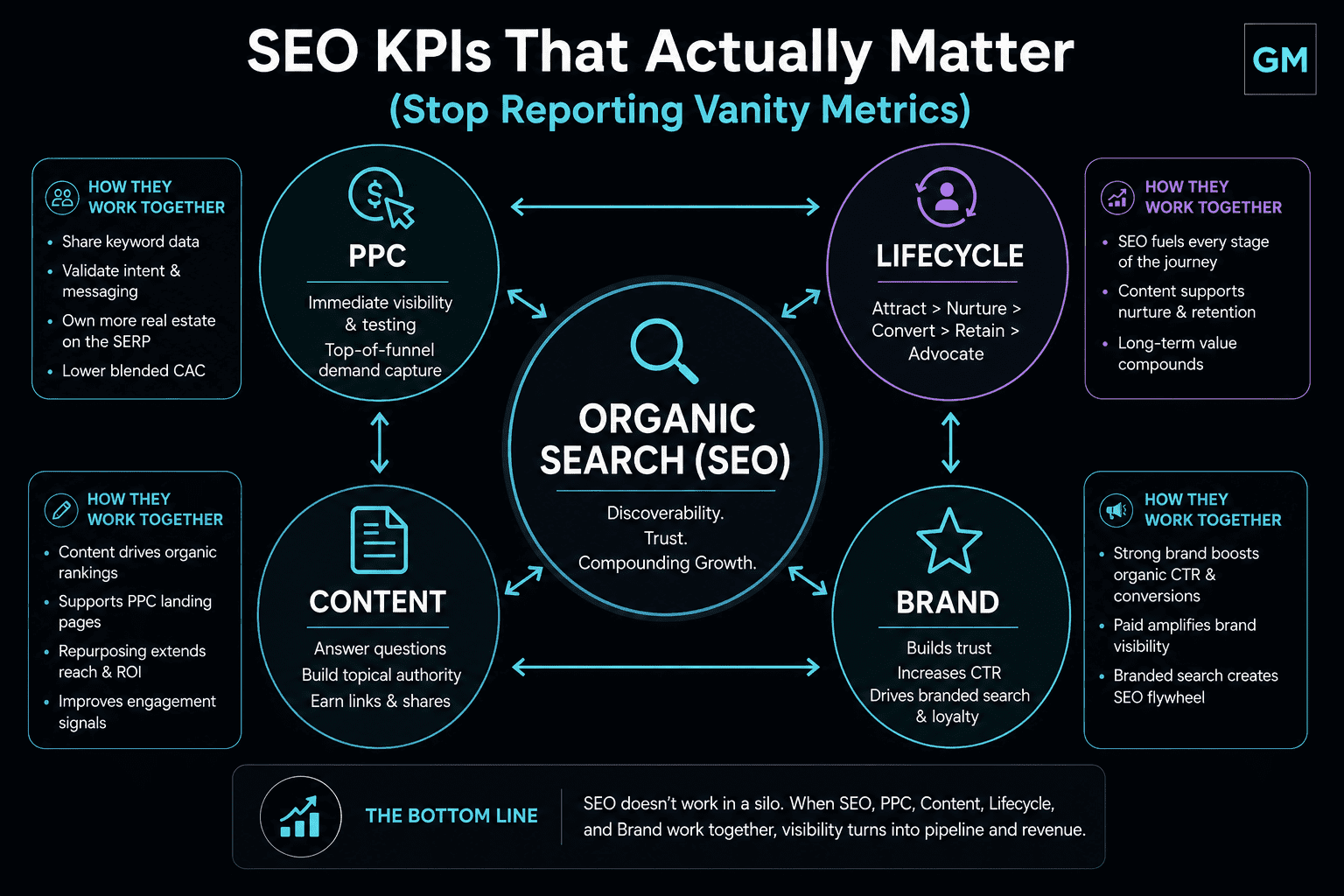
SEO is not an isolated channel
This is the part of SEO reporting that gets the least attention and matters the most.
Organic search interacts with paid search constantly. When branded organic traffic drops, paid search starts paying more for the same intent because users who would’ve found you organically are now clicking the ad. When non-branded organic gains, paid efficiency often improves because the brand is showing up in more places and converting better at every step. If your SEO KPI is climbing while PPC efficiency is silently tanking, you’re not winning. You’re shifting the cost.
Organic search interacts with lifecycle marketing. A returning organic user who first found you through a CRM email is a different acquisition cost than a cold organic visitor. Mixing these in a single “organic traffic” number hides the actual story. The lifecycle nudge did the work. Organic captured the result. Both should get credit, not just one.
Organic search interacts with content and growth. A piece of content that wins AI Overview citations but loses click-through might still be feeding ChatGPT and Gemini answers that drive demo bookings or branded searches later. The conversion path is not click-only anymore, and treating click-loss as a failure misses the new layer of attribution. Triple Whale’s writeup of how cross-channel attribution actually works in practice is a good baseline for the multi-touch view.
Organic search interacts with brand. Branded organic search volume is a downstream signal of every other channel working. It’s the closest thing to a brand health metric SEO can claim. PR, paid social, podcast appearances, an offline event all feed branded search. If branded volume is growing and you’re an SEO, you’re benefiting from work the rest of the marketing team did, and the honest report says so.
The reporting takeaway is simple. If your SEO KPI is improving in isolation but the overall growth number is flat, something is being double-counted or starved. Pure-organic reporting that ignores PPC interaction, lifecycle assists, and brand effects is the reason SEO programs get questioned. The work might be solid. The framing is what’s failing.
The KPIs that actually defend the SEO budget
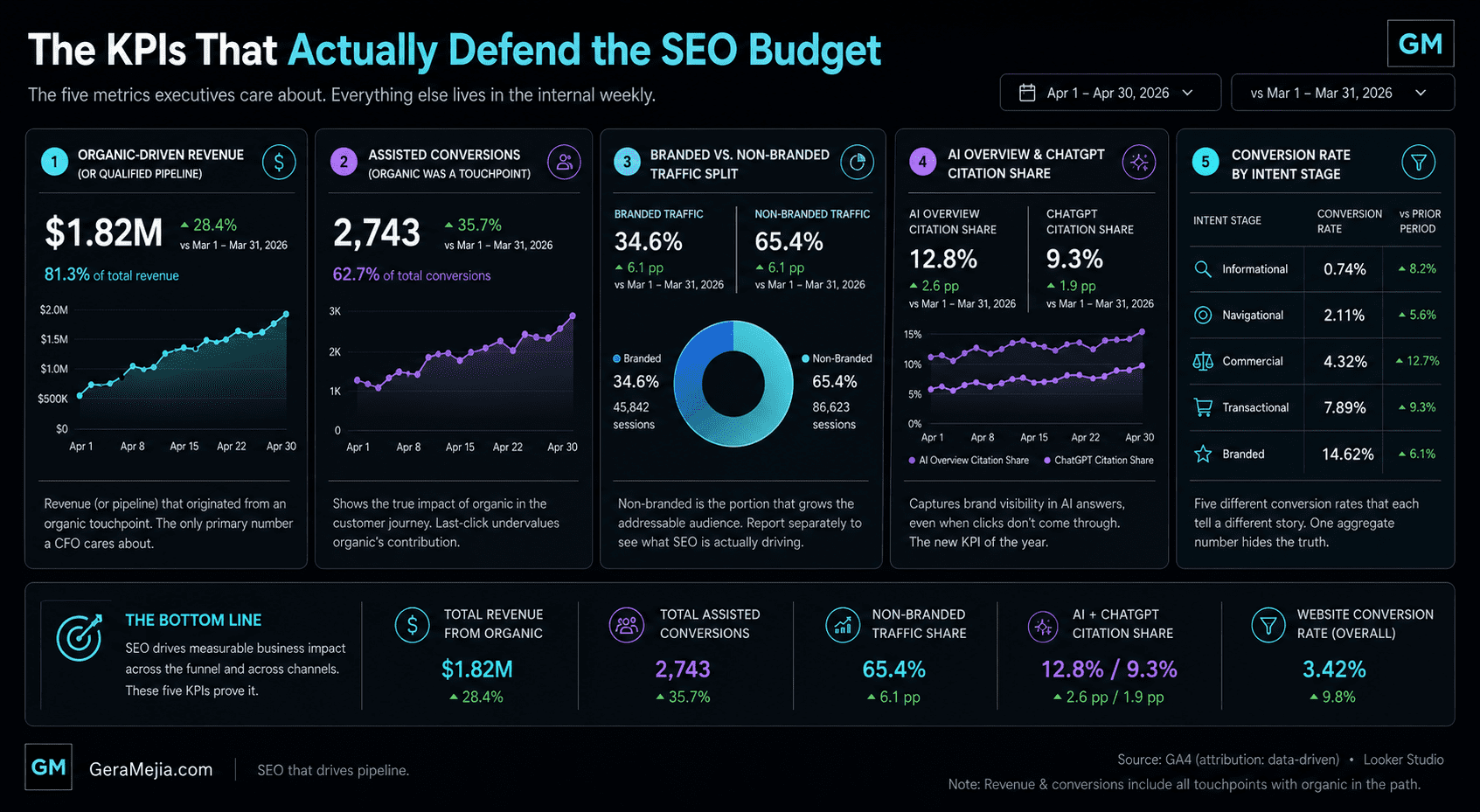
These are the five I’d put on an exec deck. The rest goes in the internal weekly.
Organic-driven revenue, or qualified pipeline for B2B. This is the only KPI a CFO cares about as a primary number. For e-commerce it’s GA4 attribution with a non-last-click model. For SaaS or B2B it’s pipeline that originated from an organic touchpoint, even if the close came through sales or paid.
Assisted conversions where organic was a touchpoint on the path. This is where the cross-channel reality shows up. A user might find you via organic search, leave, come back via a paid retargeting ad, and convert. Last-click attribution gives all the credit to paid. The assisted-conversion view shows that organic was the first or middle step. Search Engine Land’s 2026 data on ChatGPT traffic converting 31% higher than non-branded organic search is one of many recent data points showing the multi-touch reality.
Branded versus non-branded traffic split as a demand-generation signal. Branded captures demand someone else created. Non-branded is the part of organic that actually grows the addressable audience. Reporting these as two separate numbers (not one combined “organic” total) lets the business see what SEO is doing versus what other channels are creating.
AI Overview and ChatGPT citation share for the topics that matter. This is the new KPI of the year. If your content is getting cited in AI answers, that’s brand visibility even when the click doesn’t come through. The mechanics for tracking this are still maturing, but the KPI itself is no longer optional.
Conversion rate segmented by intent stage. Aggregate conversion rate across all organic traffic is useless because it mixes informational visits with commercial visits with branded transactional visits. Segmenting by intent gives you five different numbers that each tell a different story instead of one number that hides the truth.
How to set up purpose-driven measurement
The framework I use to set up SEO KPIs for a new client or a new quarter has five steps.
Step 1: Write down the single business goal the client is measuring itself against this quarter. Not the SEO goal. The business goal. Revenue, qualified pipeline, signups, ad impressions, whatever it is.
Step 2: Define the SEO KPI that maps directly to that business goal. Not a generic SEO best-practice KPI. The one that, if it moves, the business goal moves with it.
Step 3: Check the cross-channel interaction. Does this KPI improve while PPC efficiency drops? Does it improve while lifecycle conversions hold flat? Does it improve while brand search volume stays static? If yes to any of these, the KPI is hiding something.
Step 4: Pick an attribution model that’s not last-click. Linear, time-decay, position-based, or data-driven. Whichever fits the business. Last-click is theater for SEO because it under-credits the touchpoint that started the path.
Step 5: Report at the cadence the business cares about. Weekly is too noisy for most SEO KPIs. Monthly is usually right. Quarterly for exec review. Match the cadence to the decision cycle, not to the tool’s default.
The tactical work behind these steps matters too. Filtering branded versus non-branded queries in Google Search Console requires a regex setup most SEOs haven’t built. Quattr has a clean tutorial on how to do that which is worth saving. GA4 custom dimensions for intent segmentation need to be set up before they generate useful data. Multi-touch attribution requires GA4 to actually be configured with non-last-click models turned on, which is not the default.
This is the part nobody loves doing, and it’s where the framework I use to decide what’s worth measuring versus what’s noise saves time. Not every KPI needs to be tracked, and not every tool needs to be in the stack. The KPI you defend is the one connected to a business goal, instrumented with a non-last-click model, and reported at a cadence that respects the decision cycle.
Final thoughts: SEO is not a one-ticket ride
Vanity metrics are the comfort blanket for SEOs who can’t connect the work to a business outcome. The KPIs in this article are harder to set up, but they’re the only ones that defend the budget when growth or finance asks the hard question.
SEO programs that get cut almost always share one trait: the team reported them as isolated wins. The ones that survive past the first budget review report SEO as part of the cross-channel story, with attribution that respects the actual conversion path.
Find me on LinkedIn if you want to compare KPI decks or talk through what you’d cut from yours.
FAQ
Why are SEO KPIs different for SaaS, e-commerce, and lead-gen businesses?
Because each business measures itself by a different outcome. SaaS measures activated trials and qualified pipeline. E-commerce measures revenue and repeat purchase. Lead-gen measures cost-per-lead and SQL rate. The SEO KPI you report has to map to the business KPI the company is being measured against. A generic SEO KPI like “organic traffic” tells none of these businesses what they actually need to know.
What are the worst SEO vanity metrics to stop reporting?
Domain Authority, raw GSC impressions without intent context, average keyword position across all keywords, and indexed pages count. These metrics belong in the internal SEO weekly for triage. They do not belong on an executive deck because they don’t connect to a business outcome and they don’t change when the underlying organic work changes in the way the business cares about.
How does SEO interact with paid search, lifecycle marketing, and brand?
Organic and paid trade off constantly. When branded organic drops, paid pays more for the same intent. Organic and lifecycle compound, because returning organic users from CRM emails carry different acquisition economics than cold organic. Organic and brand are tightly coupled, because branded organic volume is downstream of every other channel building brand awareness. Reporting organic in isolation hides all three interactions.
What’s the right attribution model for measuring SEO impact?
Anything except last-click. Linear, time-decay, position-based, and data-driven all credit multiple touchpoints on the conversion path, which is closer to how customers actually convert. Last-click systematically under-credits SEO because organic is usually a discovery or middle-funnel touchpoint, not the final click before conversion. Pick the model that fits the business and stick with it.
How do I report SEO performance to executives who don’t care about rankings?
Use a five-line exec dashboard with KPIs that map to the business goal: organic-driven revenue or qualified pipeline, assisted conversions where organic was a touchpoint, branded versus non-branded split, AI Overview citation share, and conversion rate by intent stage. Each KPI should be defensible in 30 seconds. Skip rankings, Domain Authority, and impressions entirely on the exec view.
Is Domain Authority still useful as an SEO KPI in 2026?
As a KPI on a reporting deck, no. Domain Authority is a vendor proxy for backlink quality, not a business outcome. It can be useful internally for benchmarking against competitors or triaging which sites are worth pursuing for links. Treat it as an operational signal, not as something the business should be measured against.
Sources & References
- Backlinko’s roundup of the SEO KPIs that actually matter — backlinko.com
- Search Engine Journal called it out plainly in a piece titled “Why Your SEO KPIs Are Failing Your Business” — searchenginejournal.com
- Neil Patel’s breakdown of the vanity metrics worth retiring — neilpatel.com
- Triple Whale’s writeup of how cross-channel attribution actually works in practice — triplewhale.com
- Search Engine Land’s 2026 data on ChatGPT traffic converting 31% higher than non-branded organic search — searchengineland.com
- Quattr has a clean tutorial on how to do that — quattr.com