Every guide on becoming an SEO freelancer starts at zero — build your skills, create an Upwork profile, get your first $500 client. That’s not this post.
This is for people who already know SEO and are trying to figure out whether going independent in 2026 makes sense — and how to do it without starting from scratch. The market is different now. AI has changed what clients need, what you can charge, and how you need to position yourself. This guide covers the full picture: positioning, pricing, finding clients, and building a practice that lasts beyond the next algorithm shift.
The honest reality: the SEO freelancer market has two very different trajectories right now. Commoditized execution work is getting squeezed by AI tools and cheaper operators. Strategic, AI-era SEO is commanding more than ever. The difference between the two tiers isn’t just skill level — it’s positioning. This post is about how to land in the second category.
Is Going Independent Still Smart in 2026?
Short answer: yes — if you’re positioning for the strategic tier.
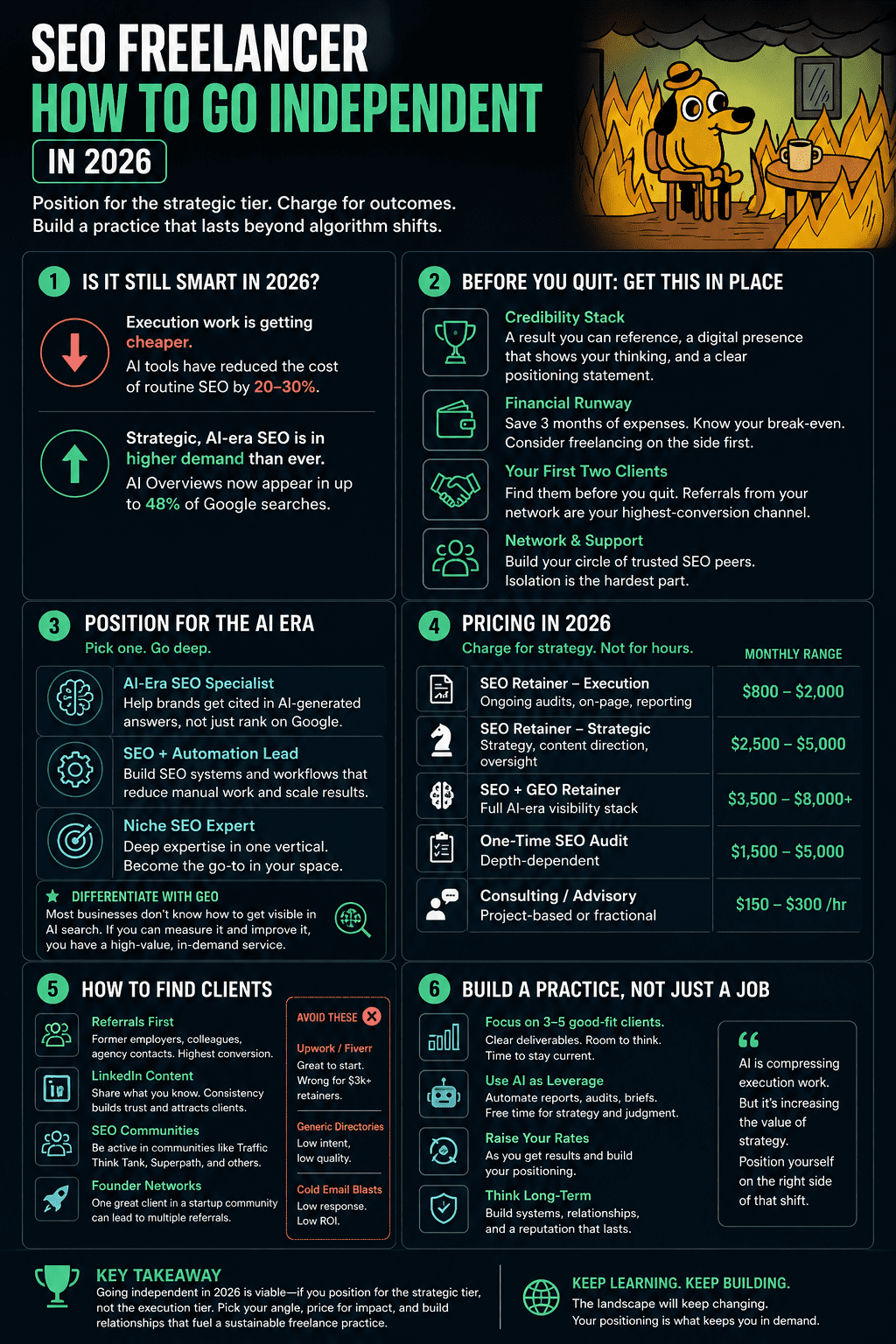
AI tools have reduced the cost of routine SEO work by 20–30% — basic content creation, reporting, simple audits. That compression is real and it’s hitting the bottom of the freelancer market hard. If your current skill set is primarily execution (pulling reports, building links, implementing basic on-page changes), the market is harder than it was two years ago.
What hasn’t compressed: strategy, judgment, client relationships, AI-era expertise. Practitioners who understand GEO, automation, and content strategy in an AI search environment are in stronger demand than at any prior point. AI Overviews now appear in up to 48% of Google searches, and most businesses don’t know how to think about visibility in that environment — let alone measure it. That gap is where the opportunity lives.
Before You Quit — What You Actually Need in Place
This isn’t a “quit your job” post. It’s a prerequisites check.
Your Minimum Viable Credibility Stack
Before you go independent, you need three things:
- A result you can reference. It doesn’t have to be your own client. Work you did at an agency counts — as long as you can speak to the strategy, the decisions, and the outcome.
- A digital presence that shows your thinking. A personal website or active LinkedIn profile. Not a resume — evidence of how you think about SEO. Building my own website as a live demo of my capabilities is exactly this approach — your site is your best portfolio piece.
- A clear positioning statement. Who you help, with what specific outcome, and why you specifically. “I do SEO” is not a positioning statement.
Financial Runway
- Minimum 3 months of personal expenses saved before going fully independent
- Know your break-even: what monthly client revenue covers your actual costs (tools, taxes, insurance, living)
- Consider the “bridge” approach: freelance on the side before the full jump — your first two clients don’t need to know you’re still employed elsewhere
Your First Two Clients
The biggest mistake: waiting until after you leave to start finding clients. The best time to find your first two clients is while you still have a salary. Talk to former colleagues, former managers, agency contacts. Referrals from people who’ve seen your work are your highest-conversion channel — by a wide margin.
Positioning in the AI Era — The Most Important Section
The Problem With “I Do SEO”
Too broad. Instantly commoditized. Every AI tool and cheap operator also “does SEO.”
Clients in 2026 are asking a different question: “Can you help me get found in AI search — not just on Google?” If your positioning doesn’t address that, you’re competing on price with everyone else who “does SEO.”
Three Positioning Options That Work Now
Pick one. Don’t try to be all three.
| Positioning | Who It’s For | Example Pitch |
|---|---|---|
| AI-Era SEO Specialist | Practitioners current on GEO, AI Overviews, LLM optimization | “I help SaaS brands get cited in AI-generated answers, not just rank on Google” |
| SEO + Automation Lead | Practitioners who can build workflows and reduce client overhead | “I build SEO systems that run with less manual work — so your team can focus on strategy” |
| Niche SEO Expert | Deep expertise in one vertical (fintech, health, B2B SaaS) | “I work exclusively with Series A-B SaaS companies scaling organic from 0 to traction” |
The narrower you go, the easier you are to refer. “She’s the B2B SaaS SEO person” travels faster in a network than “he does good SEO work.”
If automation is your angle, decide whether you actually need an AI agent or a simpler script will do the job before you spend a weekend building anything. Most freelancers overinvest in tooling early.
The GEO Angle as a Differentiator
Most SEO freelancers don’t offer GEO services yet. That’s the opportunity.
Clients are asking: “Are we showing up in ChatGPT? In Perplexity? In AI Overviews?” Most agencies don’t have a clean answer. If you can measure it, frame it, and improve it — you have a service that most of the market can’t deliver yet. Google’s own guidance now addresses AI features directly, which gives you credibility hooks when pitching GEO services to skeptical clients.
Pricing — What to Actually Charge in 2026
Most SEO freelancers price too low out of fear of losing the deal. That’s the wrong calculation.
Current Market Rates
According to 2026 market data:
- Hourly: $75–$200/hour depending on scope and positioning
- Entry retainer (execution-focused): $800–$2,000/month
- Mid-level retainer (strategy + execution): $2,500–$4,500/month
- Senior / strategic retainer: $4,500–$8,000+/month
| Service Type | Monthly Range | Notes |
|---|---|---|
| SEO retainer — execution | $800–$2,000 | Ongoing audits, on-page, reporting |
| SEO retainer — strategic | $2,500–$5,000 | Strategy, content direction, oversight |
| SEO + GEO retainer | $3,500–$8,000 | Full AI-era visibility stack |
| One-time SEO audit | $1,500–$5,000 | Depth-dependent |
| Consulting / advisory | $150–$300/hr | Project-based or fractional |
Rates vary by market, client size, and your positioning. Source: Backlinko SEO pricing data, 2026
Pricing Mistakes That Kill Your Practice
- Hourly pricing for ongoing work. You get penalized for getting faster. Move to retainers.
- Discounting to close. It sets the wrong expectation for the entire relationship.
- Not raising prices as you get results. Your first client rate shouldn’t be your third-year rate.
Finding Clients in 2026 — What Actually Works
Channels That Convert
Former employers and colleagues — highest conversion, lowest effort. If they’ve seen your work, they already trust you. This is where most first clients come from.
LinkedIn content — not just having a profile, but posting consistently about what you actually know. Observations, tests, honest takes on what’s working. Polished case studies are nice but consistency beats perfection.
SEO community referrals — Traffic Think Tank, Superpath, and similar practitioner communities send real work to people who are known in them. Membership is worth it if you’re active.
Founder networks — startup founders talk to each other. One good client in a startup community becomes three referrals if you do good work.
Channels That Don’t Convert Well at the Strategic Tier
- Upwork and Fiverr (appropriate for starting out, wrong positioning for $3,000+/month retainers)
- Generic freelancer directories
- Cold email blast campaigns without extreme specificity
Your Personal Brand as a Client Channel
Posting on LinkedIn consistently about what you actually know is the highest-leverage long-term client acquisition channel for SEO practitioners. Not polished press releases. Real observations from real client work. What you tested, what moved, what didn’t. That kind of content builds trust faster than any portfolio page.
Google’s increasing focus on E-E-A-T signals — experience, expertise, authoritativeness, trustworthiness — applies to individual practitioners’ online presence just as it does to websites. Your personal brand is your domain authority.
You’re Building a Practice, Not Taking a Job
The freelancer mindset shift that takes longest to make: you’re the CEO of a one-person business, not an employee without a manager.
What sustainable looks like: 3–5 good-fit clients, clear deliverables, room to stay current on the field. What unsustainable looks like: 12 small clients, constant context-switching, no time to think.
AI tools are your leverage. What you can automate in your own workflow — reporting, initial audits, content briefs — frees time for the work only you can do: strategy, judgment, client relationships, staying current. The same AI capabilities that’re compressing commoditized SEO work are your operational advantage if you use them proactively.
What’s Still Unsolved
The hardest part of going independent isn’t the skills — it’s the isolation. No colleagues, no internal context, no one to sanity-check an approach with.
The fix: build your own informal board. A small group of other SEO practitioners you trust, talk to regularly, and share real work with. This takes time to develop. If you’ve found a structure for this that actually works, I want to hear it — LinkedIn or the comments.
Takeaway
Going independent as an SEO professional in 2026 is viable — but only if you position for the strategic tier, not the execution tier.
- Pricing: charge for outcomes and strategy, not hours and tasks
- Positioning: pick one specific angle — AI-era specialist, automation lead, or niche expert
- The GEO opportunity: most freelancers haven’t built this capability yet — significant first-mover advantage if you move now
- Client acquisition: start with referrals from your existing network, build from there
If you’re thinking about making the jump or recently did, find me on LinkedIn. I’m building a follow-up post on this — real numbers, real positioning decisions, real stories from practitioners in the field.
FAQ
How much does an SEO freelancer make in 2026?
Rates vary significantly by positioning. Execution-focused freelancers typically earn $800–$2,000/month per client. Strategic SEO consultants with AI-era expertise — GEO, automation, content architecture — typically charge $3,500–$8,000+/month per client. The gap between the two tiers is growing.
Do I need certifications to become an SEO freelancer?
No. Results beat certifications every time. A portfolio showing measurable organic growth matters more than any certificate. Semrush Academy and Ahrefs Academy are both free and worth working through — not as credentials, but as tools to stay current.
How do I find my first SEO freelance clients?
Your fastest path is referrals from your existing network — former employers, colleagues, agency contacts. Before spending time on cold outreach or platforms, contact three people who know your work directly and ask if they know anyone who needs SEO help. Most first clients come from exactly this.
Should I specialize in a niche as an SEO freelancer?
Yes, eventually. Generalists get commoditized faster. A niche (SaaS, fintech, health, ecommerce) increases your close rate, justifies higher pricing, and makes referrals easier. Start broad if your pipeline requires it, but move toward a niche as quickly as your revenue allows.
How is AI changing SEO freelancing in 2026?
AI is compressing the value of execution work — basic content, reporting, simple audits. It’s simultaneously increasing demand for strategic work — GEO, content strategy, AI workflow design. Freelancers who only execute are under pricing pressure. Those who lead with AI-era strategy are in stronger demand than at any prior point in the industry.
What’s the difference between an SEO freelancer and an SEO consultant?
Mostly positioning and scope. Consultants typically operate at a more strategic, advisory level — sometimes fractional engagements, higher hourly rates, less hands-on execution. Freelancers often include more direct execution in their retainers. In practice, the line is blurry. What matters is how you position the relationship, not the label.
Sources & References
- AI tools have reduced the cost of routine SEO work by 20–30% — semrush.com
- AI Overviews now appear in up to 48% of Google searches — seranking.com
- Google’s own guidance now addresses AI features directly — developers.google.com
- According to 2026 market data — backlinko.com
- Google’s increasing focus on E-E-A-T signals — developers.google.com