
By the time Opus 5.5 arrived, I had made a very adult financial decision: one AI subscription was enough. I had lost my job, and ChatGPT was already doing what I needed. Claude Code looked fun, but “fun” was not a great reason to add another monthly bill.
Then my feed filled up with people building ridiculous, beautiful things. I got curious. So I did what any responsible adult would do and paid $20 for Claude Pro to see what I was missing.
At first, I wasn’t impressed. I asked Claude Code to make random websites and little experiments without much context. It made random things. Shocking, I know. The problem wasn’t that Opus 5.5 couldn’t build. I hadn’t given it a reason to build anything specific. This time, I wanted the subscription to answer an actual question.
Key takeaways
- My first prompts produced forgettable work because I hadn’t decided what I wanted to explain. Giving Opus 5.5 a real question changed the experiment.
- The Sentinel simulation lets you cause a failure and watch an agent respond. You can compare a small content workflow with a more complicated GTM pipeline.
- The most interesting use for this kind of build may be explaining everyday work to people who don’t live inside our tools, from pipeline handoffs to a product’s value for different customers.
The question that gave the experiment a point
Anthropic reports a 66.4% score for Opus 5.5 on Terminal-Bench 4.0 at xhigh effort. That’s a benchmark, not a review of my little project. My question was smaller: who watches AI agents when something goes wrong? I wanted to see whether I could make that idea easier to grasp.
While reading about Meta’s Muse, I came across its explanation of a Sentinel: a separate component that checks whether certain agent actions can proceed. That made me wonder how to show the idea to someone who doesn’t want to read a security architecture document. Ryan Sael’s interactive explainers were another nudge. They make you want to click things and see what happens.
So I opened Claude Code and built a Sentinel simulation. It is an interactive explanation inspired by the idea of a watching agent, not a replica of Muse or a production security system.
Break something and see what happens
The game has two setups:
| Feature | Content automation | GTM pipeline |
|---|---|---|
| Agents | 6 | 8 |
| Sentinels | 1 | 2 |
| What gets more complicated | A smaller sequence of content tasks | Marketing and pipeline zones, more handoffs, and customer-facing consequences |
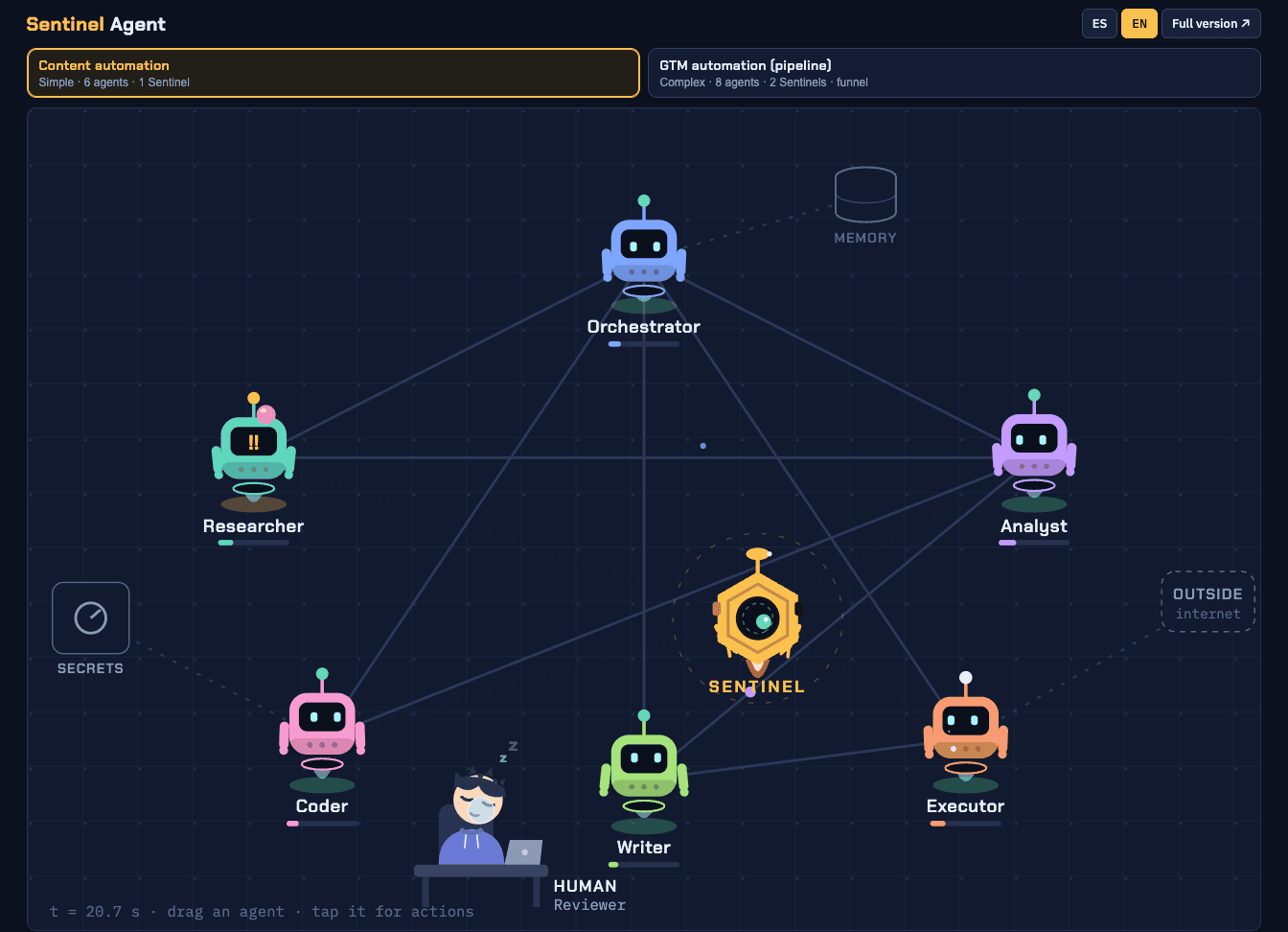
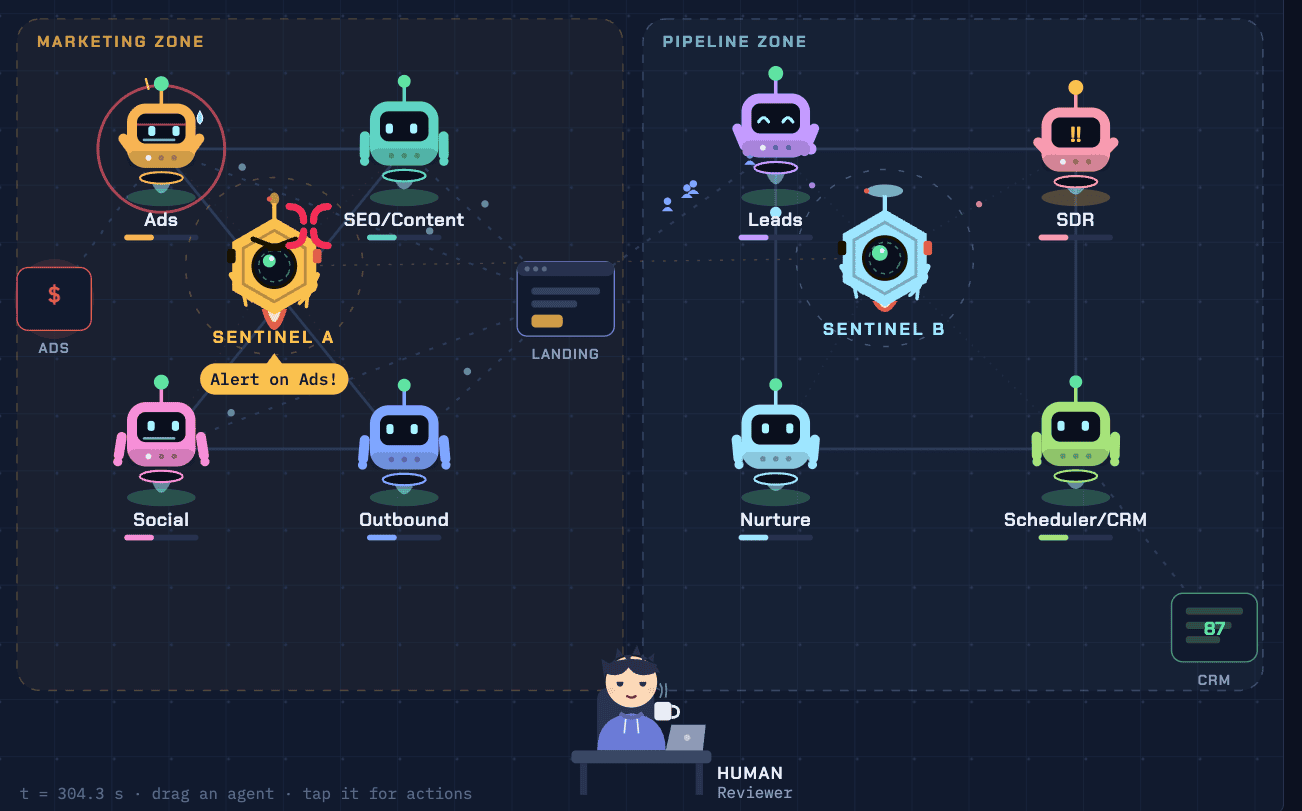
Pick a mode, trigger a failure, and watch what the Sentinel detects and does. You can change the thresholds, turn on sound, take the guided tour, or inspect the audit log. There is a comparison view, a “How it works” section, and a glossary if you want to go deeper. The point is to see why a human sometimes needs to step in, and why sending every tiny issue to a person would make the whole thing unbearable.
I also tested Opus 5.5 on websites and small animations. The DNA animation here is one of those experiments. It isn’t part of the Sentinel game, but I liked how it turned out.

What would you build for your actual job?
This is where I think the experiment becomes useful at work. If you lead a GTM team, give new hires a pipeline they can break. Let them follow a lead from an ad to the CRM, miss a handoff, and see what happens to speed to lead. That’s clearer than another 40-slide onboarding deck.
If you’re a product marketer, let someone choose an ICP, see the problem they have, and watch which part of your product changes the outcome. That could explain the value proposition better than another paragraph about “streamlining workflows.”
Or use it in a client report to show where leads drop out and which numbers would change your decision. An interactive view could make the judgment behind GTM execution visible to people outside the team.
There are things I want to improve. But this test showed me what Opus 5.5 can do when I bring a clear question to it. If you try the game, break a few things and tell me what would make it clearer or more useful.
See this experiment alongside the other things I’ve built.