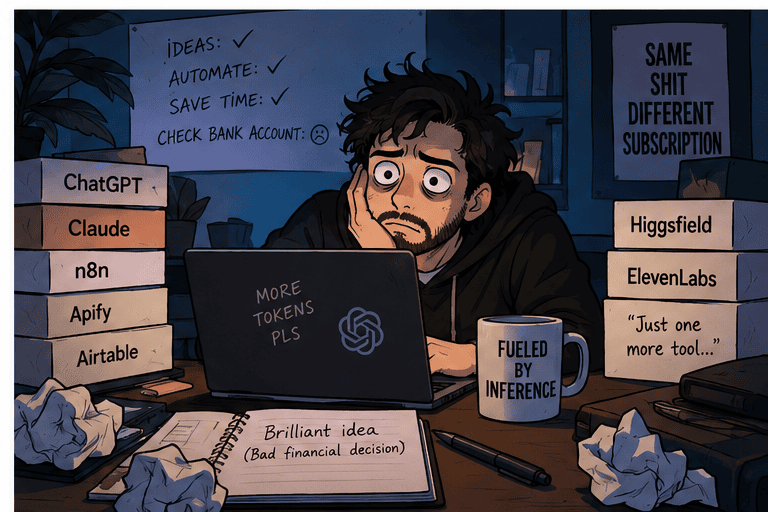
In 2021, I accidentally picked up one of the most expensive hobbies I have.
Coffee.
I was working for a company that gave employees a learning stipend. It was actually a good benefit because you could use it to learn almost anything. So instead of buying a Udemy course on how to make your first $10K with $20, I decided to take a barista course.
It was December, I was on PTO, and I was bored. The course sounded fun, the company was paying for it, so why not?
I loved it.
The problem is that the course introduced me to specialty coffee, and suddenly coffee became more than just coffee. I started buying better beans, then a French press, then a V60, then a Chemex. At some point I convinced myself that I obviously needed an espresso machine too, because apparently making coffee in five different ways was not enough.
That was another $500.
I have never calculated how much I have spent on coffee since that course, and I have no intention of doing it. Some numbers are better left undiscovered.
But recently I realized I have done exactly the same fucking thing with AI.
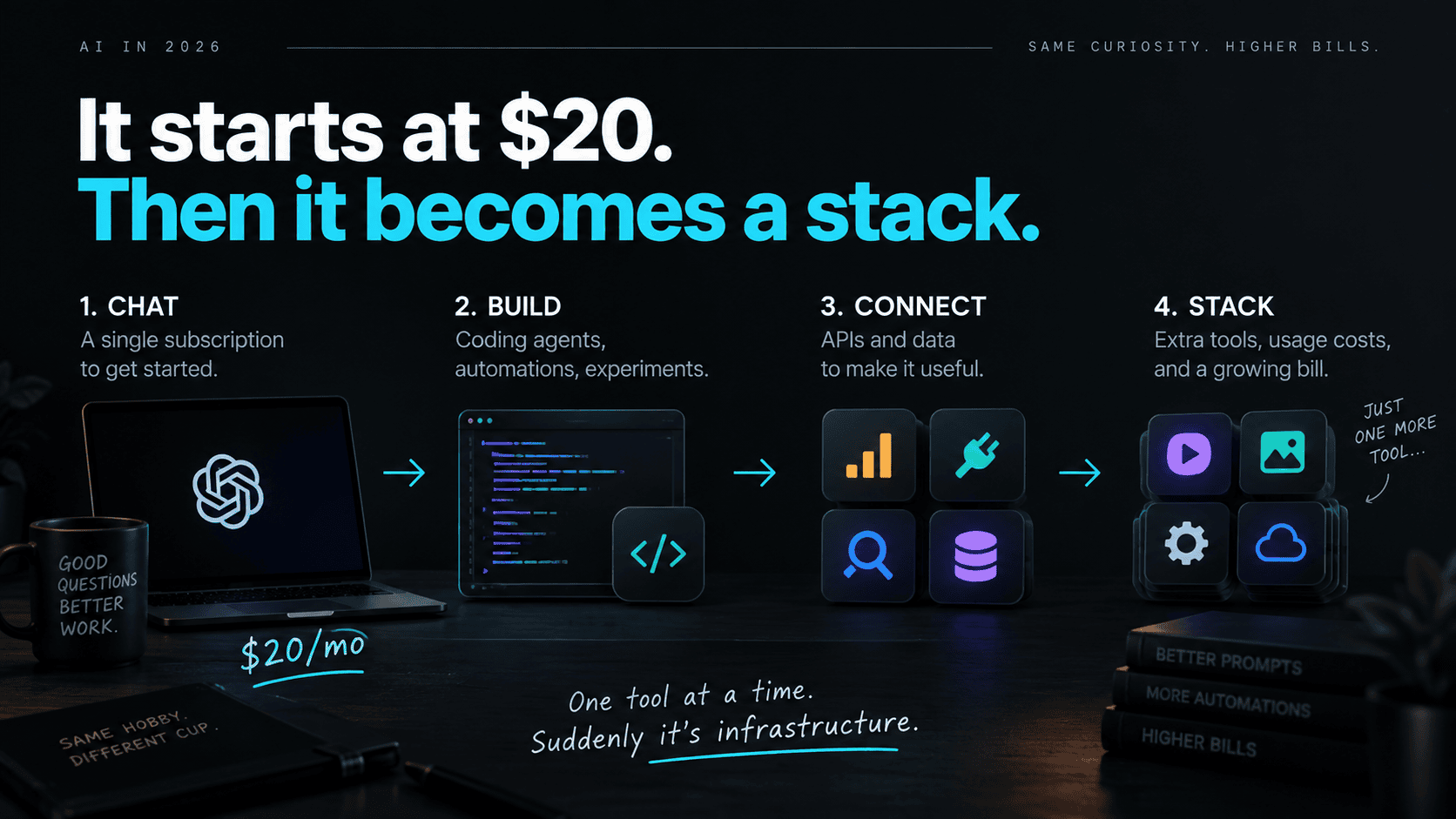
You start with ChatGPT Plus or Claude Pro. Twenty bucks a month feels almost stupidly cheap for something that can research, analyze data, write code, help with content, and answer the random question you should probably have Googled yourself.
Then you start learning what else it can do.
Chat is no longer enough. You try Codex or Claude Code. Then you build an automation. Then you connect it to Search Console or GA4. Eventually you want the workflow to run by itself, so you add n8n and maybe an API somewhere in the middle.
Nothing feels particularly expensive on its own.
Then one day you look at the invoices and realize your harmless little $20 subscription has somehow turned into infrastructure.
Watch the short version
Table of contents
AI can genuinely still cost you $20
I do not want to turn this into one of those articles where somebody discovers cloud computing costs money and declares that AI is doomed.
For a freelancer, AI can still be ridiculously cheap.
ChatGPT Plus is currently $20 per month. Claude Pro sits in the same general entry level subscription category, and for plenty of people one of those products is enough.
If you mainly use AI to research, write, analyze spreadsheets, look at marketing data, or help with code, I would start there. I would not immediately buy the biggest plan available because somebody on LinkedIn told you that your career depends on having access to the newest model released twelve minutes ago.
There is also a lot you can connect without immediately adding another bill.
Google Search Console and GA4 are good examples. You can authenticate to their APIs with OAuth and retrieve your own data subject to usage quotas. Search Console allows substantial request volumes, while GA4 uses quota tokens based on query complexity. Neither works like an LLM API where every million tokens generates another line on your bill.
That means I can pull Search Console data into a workflow without paying Google every time I ask for clicks and impressions.
The expensive part starts when I ask an LLM to do something with that data.
If I run one analysis for myself, who cares? If I run that analysis every morning across 40 clients, now the economics are different.
That distinction matters more than asking whether ChatGPT costs $20 or $200.
Using AI and building with AI are not the same thing
When I am inside ChatGPT asking questions, I am not thinking about tokens. I pay for the product and use it.
That is exactly how it should work.
OpenAI even makes the separation explicit. ChatGPT Plus costs $20 per month, while API usage is billed separately. The subscription and the infrastructure product are not the same thing.
Once you start building workflows, though, the meter becomes much more visible.
Maybe I build something that pulls Search Console data, sends it to a model, and gives me a summary every morning. I can run n8n myself using its Community Edition, which means I do not necessarily need to pay for n8n Cloud.
Great.
I saved one subscription.
The model still wants to get paid.
That is the part that gets lost in the whole "just self host it" discussion. Self hosting can remove one cost, but it does not magically make every service connected to the workflow free.
If the workflow sends millions of tokens through a paid model every month, that bill still exists.
And if I add a scraper or another external service because the workflow needs data that Search Console does not provide, I have added another meter.
This is where AI stops behaving like software I subscribe to and starts behaving like a system I operate.
Tokens are getting cheaper. We are just using a shitload more of them
This is the contradiction that makes AI pricing interesting in 2026.
On paper, inference is getting cheaper.
Look at a few current API prices.
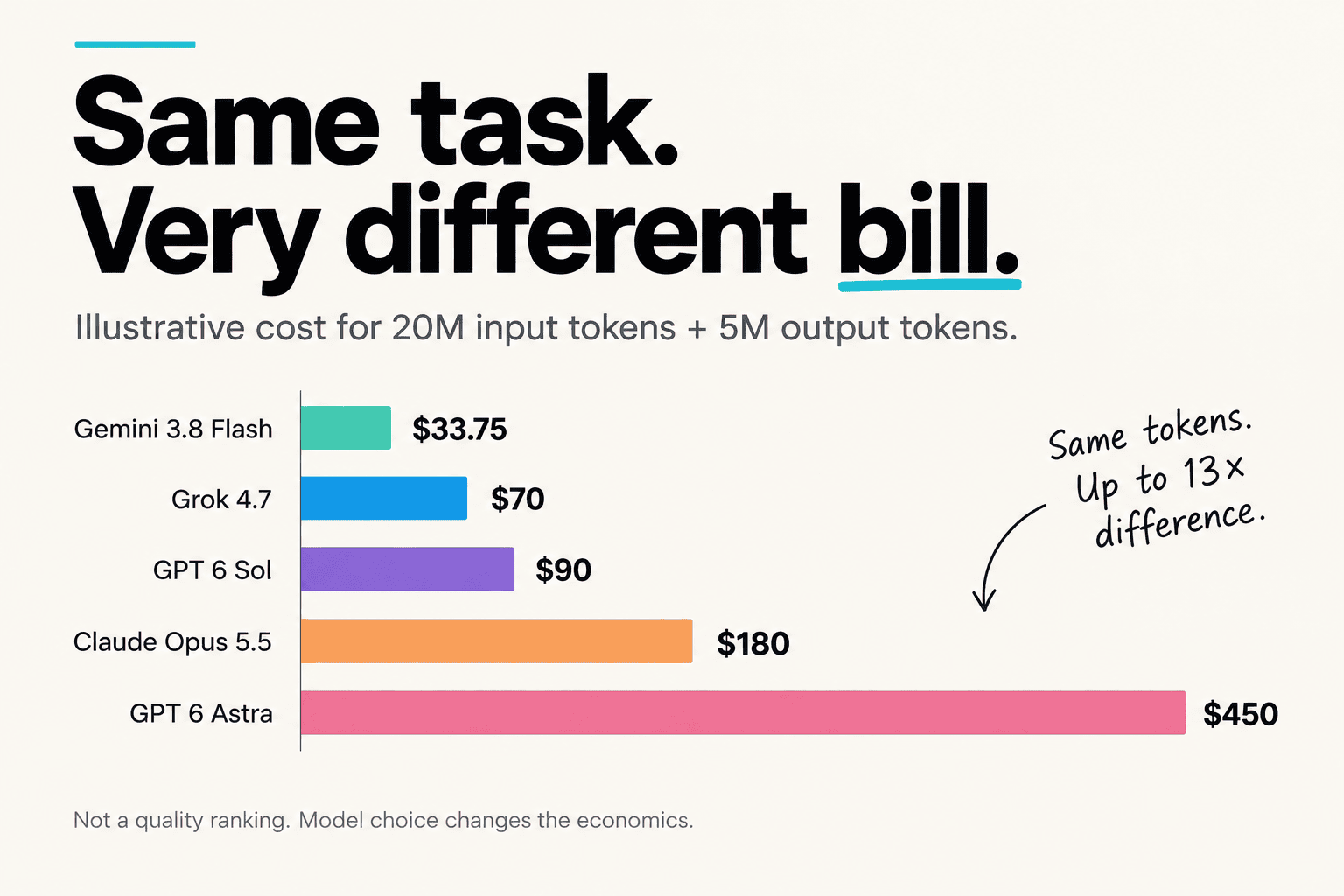
| Model | Input per 1M tokens | Output per 1M tokens |
|---|---|---|
| Gemini 3.8 Flash | $0.75 | $3.75 |
| Grok 4.7 | $2 | $6 |
| GPT 6 Sol | $2 | $10 |
| Claude Opus 5.5 | $4 | $20 |
| GPT 6 Astra | $10 | $50 |
Gemini 3.8 Flash is currently on introductory pricing through the end of 2026. Grok 4.7 is $2 for input and $6 for output. Claude Opus 5.5 is $4 and $20, while OpenAI lists GPT 6 Sol at $2 and $10 and Astra at $10 and $50 for standard short context pricing.
Those models are not equivalent, and I would not use this table to declare some dumbass winner based entirely on price.
That is not what I am trying to show.
The interesting part is the spread.
A routine classification task and a difficult coding problem do not necessarily deserve the same model. If the cheaper model solves the job reliably, sending everything through the most expensive model available is not sophisticated. It is just expensive routing.
Google Cloud makes essentially the same point in its own cost guidance:
"The key isn’t just about choosing the cheapest option."
The real goal is matching the cost and performance of the model to the workload you are running.
That sounds obvious until a new frontier model launches and everybody immediately starts using it for absolutely everything.
I know because I do it too.
I built a game and my wallet participated
When Fable 5 launched, I wanted to see what it could do, so I built a game. There was no business case for it, nobody needed it, and nobody was waiting for it. I was just curious.
And it was fucking impressive.
I kept iterating. I would ask it to add something, change a mechanic, fix a problem, then fix whatever the previous change had broken. From my perspective, I was just having fun building something.
Then I looked at my token usage.
Holy shit.
That is when this whole idea clicked for me. A model can become cheaper per token while the work we ask it to perform becomes much more expensive.
A normal chat interaction might be one request and one response. A coding agent can read a bunch of files, reason about them, write code, run it, inspect an error, modify the code, and try again.
The token price can go down while the total amount of computation goes through the roof.
Simon Willison published a great example from his own usage. He estimated that 30 days of Claude Code and Codex activity represented about $2,180 worth of API priced token usage while he was paying much less through consumer subscriptions.
His summary was wonderfully simple:
"That’s $2,180.16 worth of tokens for $200."
That difference matters a lot.
A flat subscription can hide how much inference you are actually consuming. The moment you take similar behavior and put it behind your own API account, the economics become much harder to ignore.

Now imagine the game actually matters
My game could break and nobody would care.
Now imagine I am building something that customers depend on.
Take a low cost airline reservation assistant. A customer asks to move a Friday flight to Sunday afternoon and keep their checked baggage.
That sounds like one request.
Behind the scenes, the system may have to retrieve the reservation, check availability, calculate the fare difference, understand baggage rules, and update the booking. If something fails, the agent may need to try again.
I am not going to throw a fake price on that system because without knowing the architecture, traffic, context size, model choice and failure rate, the number would be bullshit.
That is exactly the lesson.
Saying a model costs $2 per million tokens tells me about as much about the final system as telling me flour costs $2 tells me about the operating cost of a bakery.
The token price is an ingredient.
The workflow is the bill.
AWS had to build guardrails around this problem
AWS published a case study about Jamf that gets very close to what I am describing.
Jamf gave engineers broad access to Amazon Bedrock for AI assisted development. Productivity increased, but so did the need to understand what people were actually spending.
AWS describes the problem with one line:
"AI spend scales with behavior."
Then comes the part that should make anyone running coding agents pay attention. AWS says a single engineer running an agentic coding loop against a premium model can burn more tokens in a few hours than a team does in a week.
Jamf eventually built a system that tracked daily spending by engineer. As people approached their budget, access to more expensive models could be restricted while cheaper models remained available.
I love that part.
They did not solve the problem by banning AI.
They solved it by making the cost visible and using expensive models when they actually made sense.
That is a much more useful lesson for freelancers than "stop using tokens."
Then the rest of the stack shows up
The LLM is only one bill.
Maybe you are building a marketing workflow and you need to scrape websites. Apify Starter currently begins at $19 per month plus usage. Maybe you also need Airtable because several people need to review or edit the results.
Those costs are not outrageous.
That is exactly how this shit happens.
You are rarely asked to spend $500 on AI infrastructure in one decision. You add $19 here, another subscription there, then a little API usage on top.
Eventually the stack has quietly become more expensive than the original AI subscription that started the whole thing.
Content creators get hit from a different direction.
Maybe you want AI generated video, so you add Higgsfield. Then you want good voice generation, so you add ElevenLabs. Suddenly your "AI subscription" is not one product anymore.
Again, none of those tools has to be a bad purchase.
If you use them enough, they might be an incredible deal.
The problem is that all of them are very easy to justify individually.
Coffee works the same way.
Nobody buys the entire coffee shop on day one. You just keep finding one more perfectly reasonable thing to buy.
I have already seen this happen with SEO tools
This is not the first time I have watched AI turn into a pile of little recurring charges.
I went deeper into this problem when I researched the AI features being added to SEO platforms because I wanted to understand whether any of them made some friggin sense or whether we were mostly paying an AI tax with better branding.
That became my article, Every SEO Tool Has AI Now. Do Any of Them Actually Work?
The pattern was familiar.
One extra feature seems reasonable. One credit system seems reasonable. One additional tool seems reasonable.
Then you add the stack together.
That is when it starts looking stupid.
The hard question is not whether a tool can do something useful.
It is whether that usefulness deserves a recurring place on your credit card.
What about running AI locally?
There is another obvious option.
Run more of it yourself.
Tools like Ollama make local models much easier to use, and Google’s Gemma 4 family gives people increasingly capable models that can run outside the big hosted AI products.
For the right task, I love this.
If I am doing repetitive classification or processing data that I would prefer not to send to a third party API, local inference can make a lot of sense.
But "just run it locally" is also one of those pieces of advice that sounds much easier when someone else is doing the setup.
You still need hardware. You need to pick a model that works for the job. You may have to care about memory, performance and maintenance.
For somebody who likes messing with this stuff, that can be fun.
For a freelancer who only wanted Search Console analyzed, ending the evening reading about quantization probably was not part of the plan.
And local models only replace part of the stack anyway.
Ollama does not replace your scraper. Gemma does not replace your database. Running n8n locally does not suddenly make a paid video generation API free.
You can reduce costs.
You cannot wish the architecture away.
I care more about the cost of the job than the cost of the token
This is probably the biggest change in how I am starting to think about AI pricing.
I do not really care whether Model A costs $2 per million tokens and Model B costs $4 if Model A takes twelve calls to finish the job and Model B gets it right in four.
The cheaper token can still produce the more expensive workflow.
The same applies to human cleanup.
If I save two dollars on inference but spend twenty minutes fixing the output every day, I optimized the wrong thing.
So I would rather measure something like: How much does it cost me to analyze one client? How much does it cost to produce one research report? How much does it cost to qualify one lead?
Those numbers actually connect AI spending to work.
Cost per million tokens is useful for infrastructure people.
Cost per completed job is useful for deciding whether the thing is worth running.
If the client depends on it, the client needs to pay for it
This becomes especially important if you are a freelancer building systems for clients.
If I build a workflow for myself and it costs $15 a month, fine. That is my tool.
If I build something that runs an important part of a client’s operation, that is no longer just part of my personal AI stack.
Someone needs to pay for it.
Maybe the client owns the API accounts. I actually like that approach whenever possible because the cost stays attached to the business using the infrastructure.
Maybe I charge usage separately. Maybe I include an allowance in the retainer.
The pricing model can vary.
What makes no sense is running a client’s production workflow through your Anthropic account, scraper account and other services, then pretending all those charges are just part of your labor.
At that point you are subsidizing the client’s infrastructure.
That is not a retainer.
That is charity with API keys.
I am not trying to spend less on AI
This is probably the part I care most about getting right.
I am not writing this because I think AI is too expensive.
I am spending more on AI because it is becoming more useful.
That is the problem.
The models are better. Coding agents can handle much larger jobs. Automation tools make it easier to connect everything together. Creative products keep getting more capable.
It has never been easier to justify one more subscription.
And sometimes you absolutely should.
If I spend $100 every month on a tool that saves me ten hours, I am not interested in optimizing that bill down to $70 just so I can brag about my AI FinOps strategy.
The money is doing something.
What bothers me is when I cannot answer what the extra $100 is actually buying.
That is when I think about coffee.
I do not regret that barista course. I love coffee, and I use the espresso machine all the time.
But I also accumulated methods and accessories because they were interesting.
AI feels like that right now.
Every few weeks there is another model, another coding tool, another creative platform or another agent promising to become essential.
Most of them can show you something impressive.
That is why restraint is difficult.
Maybe the real question is how much AI you actually need
If I were starting again as a freelancer, I would keep it boring at first.
Pick one good subscription.
Connect free data sources such as Search Console and GA4 when they solve your problem.
Run something like n8n yourself if that makes sense for your workflow.
Then pay for APIs when you have an actual reason to use them.
The more important habit is to separate experimentation from recurring operations.
If I burn tokens for a weekend testing Fable, that is experimentation. Sometimes experimentation costs money and that is fine.
If the same workflow starts running every morning, I want to know what one run costs.
If it becomes part of a client’s business, I want to know what one customer action costs.
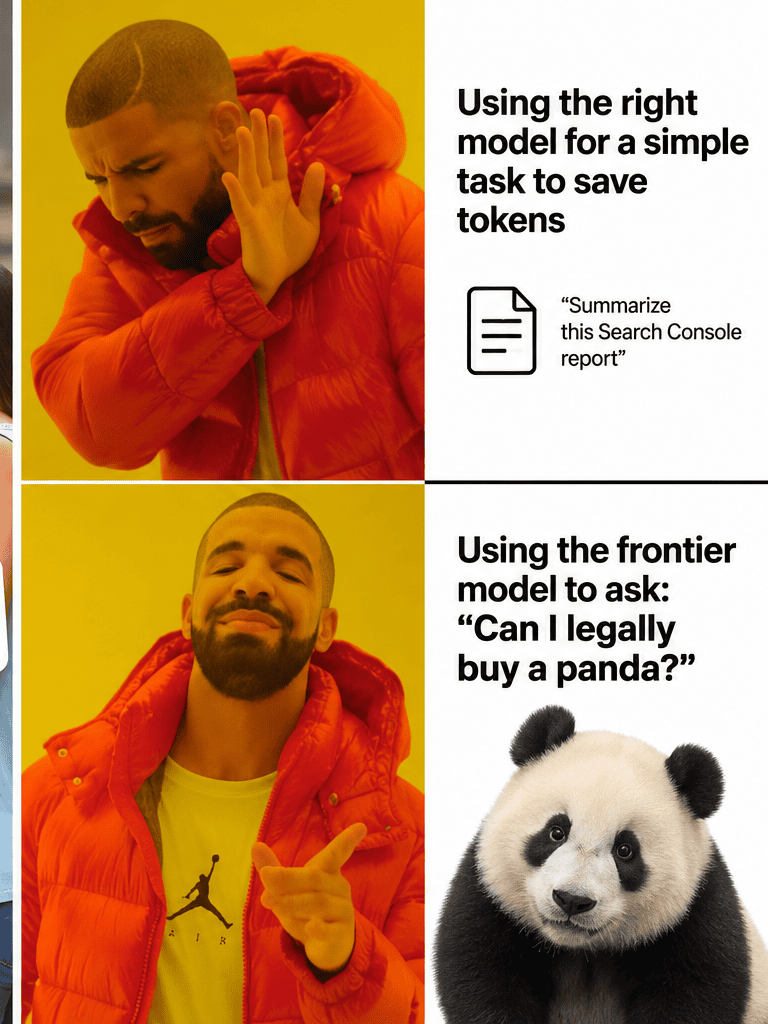
And if a cheap model can do a job just as reliably as the expensive one, I am going to use the cheap model.
Google Cloud makes this point in a more civilized way by arguing for the right balance between performance and cost based on the workload.
My version is simpler.
Do not use the Ferrari to buy groceries.
I do not think the answer is to use less AI.
I do not even think the answer is necessarily to spend less on it.
The answer is to know why you are spending the money.
Because the first $20 is easy.
Then you build something. You automate something. You add a scraper. You decide your video needs a better voice. A new model launches and obviously you have to build a pointless game just to see what happens.
Then one day you look at the invoices and realize you accidentally built the AI version of my coffee cabinet.
Except Anthropic does not even give you coffee.
Sources & References
- n8n myself using its Community Edition — docs.n8n.io
- Google Cloud — cloud.google.com
- Simon Willison — simonwillison.net
- AWS published a case study about Jamf — aws.amazon.com
- https://openai.com/chatgpt/pricing/ — openai.com
- https://developers.google.com/webmaster-tools/limits — developers.google.com
- https://developers.google.com/analytics/devguides/reporting/data/v1/quotas — developers.google.com
- https://ai.google.dev/gemini-api/docs/pricing — ai.google.dev
- https://docs.x.ai/developers/models/grok-4.7 — docs.x.ai
- https://platform.claude.com/docs/en/models/opus-5-5/overview — platform.claude.com
- https://developers.openai.com/api/docs/pricing — developers.openai.com
- https://apify.com/pricing — apify.com
- https://airtable.com/pricing — airtable.com
- https://elevenlabs.io/pricing — elevenlabs.io
- https://higgsfield.ai/creator-hub/help-center/plans/how-do-higgsfield-plans-work — higgsfield.ai
- https://ai.google.dev/gemma/docs/releases — ai.google.dev