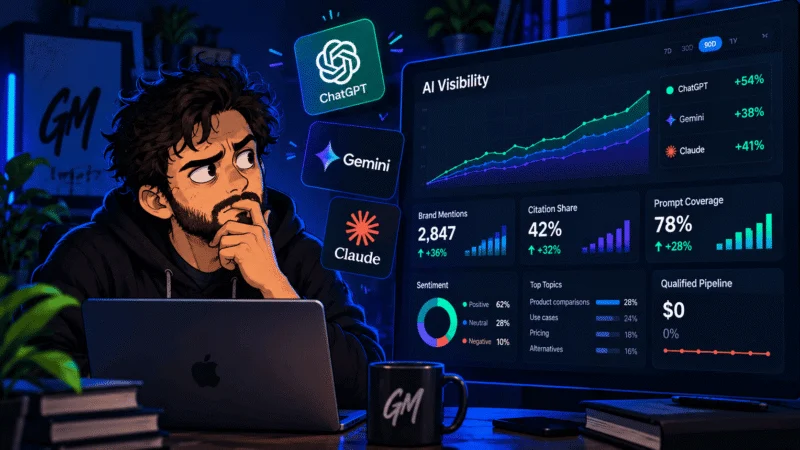
Why I'm skeptical of anyone promising to fix your AI visibility with a checklist.
I've spent a lot of time presenting GEO reports to clients. AI visibility scores, citation shares, competitor comparisons, tracked prompts. The usual stuff.
And there's something I've noticed.
Sometimes, nobody asks a single question.
You present the numbers, explain where the brand appears in ChatGPT or Gemini, show a few competitors doing better, and everyone agrees.
Great meeting, right?
Well, maybe.
The problem is that GEO is still relatively new, and many clients don't fully understand what they're looking at. They trust the person presenting the report because, supposedly, that person knows what they're talking about.
And that creates an interesting situation.
You can walk into a meeting, recommend adding HTML tables, publishing articles for LLMs, creating an llms.txt file, and getting mentioned on Reddit.
Throw in some technical explanations about how LLMs retrieve information, and you've got a pretty convincing presentation.
The client approves the recommendations, everyone leaves happy, and next month you're back with another dashboard.
But how much of that can we actually connect to business growth?
I'm not saying those tactics are useless. Some are worth testing. I've recommended technical and content improvements myself.
My issue is with people prescribing the same solutions to every business when we're still figuring out how to measure their impact.
And, unfortunately, there's a fair amount of bullshit being sold around GEO right now.
We have more data than ever. Now what?
According to Maze's research, covered by Rory Woodbridge, 77% of surveyed product marketers reported an increase in research demand, while only 19% saw an increase in resources.
The broader research surveyed 205 people working in market research. Another finding was that 97% reported using AI to draft reports and presentations.
That sounds pretty familiar.
We're expected to produce more reports, more competitive analysis, more recommendations, and somehow make better decisions with fewer resources.
AI makes a lot of that work easier.
I can collect information, analyze competitors, organize research, and prepare a report much faster than I could a few years ago.
But producing more information doesn't automatically make that information useful.
GEO is a good example.
We now have tools like Ahrefs, Writesonic, and specialized AI visibility platforms that allow us to monitor:
- Brand mentions across AI-generated answers.
- Citation share and competitor visibility.
- Performance across selected prompts.
- Changes in how AI systems describe our products.
I use these tools, and I find them incredibly helpful.
They give us a starting point. We can identify patterns, investigate competitors, and get an idea of how our brand is being represented.
And these platforms are improving. I expect their measurement capabilities to get considerably better as the industry develops.
But there's a limitation we need to understand.
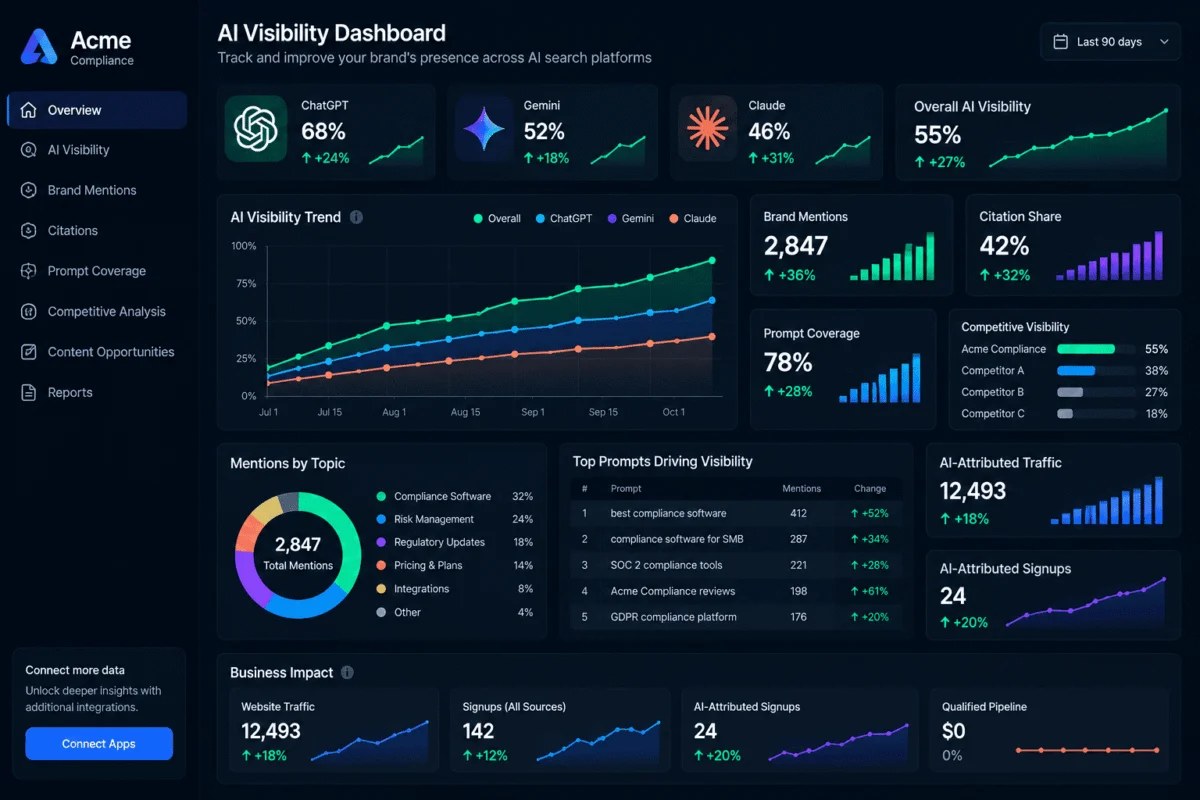
Let's say your dashboard tells you that your brand appears in 35% of the prompts you're tracking.
Okay.
What does that actually tell us?
It tells us how often your brand appeared within the specific prompts and conditions the platform monitored.
It doesn't tell us that 35% of your potential customers have encountered your brand.
Those prompts might not even reflect what your actual buyers are asking.
Topify's AI attribution framework discusses this problem by separating AI visibility from website activity and business outcomes.
And I think that's an important distinction.
We can use citation share to identify gaps or develop hypotheses.
But treating that number as the final truth about your brand's performance would be a mistake.
Maybe your GEO problem isn't even about GEO
Imagine we're working with an enterprise compliance software company.
The product is complicated. Its customers are financial institutions, and purchasing decisions involve several departments.
Compliance, legal, security, procurement. You get the idea.
A company like this isn't selling a $20 monthly subscription. Their sales cycle might take six months or longer.
Now, let's say we're reviewing their GEO performance.
Competitors appear more frequently across informational prompts, while our brand struggles to get mentioned.
What should we do?
The obvious answer might be to create more informational content.
We could identify the prompts where competitors appear, find the gaps, and start producing articles.
Fair enough.
But before spending money on that, I'd want to understand a few things.
- Are those prompts relevant to the people who actually buy our product?
- Are potential customers already reaching our website?
- Do they understand what the product does and why they should care?
- What happens between someone visiting the website and becoming a qualified opportunity?
Because we might discover something completely different.
Maybe the company already gets qualified traffic, but people aren't requesting demos.
Maybe the messaging is too technical.
Or maybe the website spends so much time explaining features that it barely communicates the problems the software solves.
For a compliance director evaluating vendors, that's a pretty big issue.
So instead of immediately publishing another 15 articles, I'd probably start by investigating the messaging and the buying process.
I'd talk to the sales team, look at CRM data, review the product pages, and examine how customers describe their problems.
From there, we could develop a hypothesis.
Perhaps we're explaining the product in a way that doesn't connect with the people making purchasing decisions.
We could test different messaging on a relevant page, monitor the results, and compare them with what we're seeing in our AI visibility reports.
And if nothing changes?
Fine. We learned something.
We can investigate another possibility.
That's how I'd approach it.
I wouldn't claim that changing the messaging will magically increase AI citations. We don't know that.
And even if visibility improves afterward, we'd still need to consider whether something else contributed.
The important part is understanding what problem we're trying to solve.
Sometimes a GEO report will point us toward a content opportunity.
Other times, it might raise questions about positioning, customer education, or how the product is presented.
That's useful information, even when the solution doesn't involve publishing more content.
You can't fix cholesterol with an HTML table
This is probably the easiest way I can explain how I think about GEO.
Imagine you go to the doctor and discover your cholesterol is high.
You decide to make some changes.
You start eating better, exercising regularly, sleeping properly, and paying more attention to your health.
Depending on your situation, you might need medication too.
After a while, your cholesterol levels improve.
Can you confidently say that eating broccoli three times a week was responsible for everything?
Probably not.
Your cholesterol is influenced by several factors, including genetics and underlying health conditions. Improving it often requires more than one intervention.
And that's how I see GEO.
Companies are spending money trying to improve a metric that's influenced by several activities happening across their marketing efforts.
Think about what goes into building a brand that people recognize and trust.
You might be:
- Publishing original research that other websites reference.
- Improving your product messaging so buyers understand what you actually offer.
- Investing in digital PR and getting mentioned in relevant publications.
- Interviewing customers and publishing real stories about their experiences.
- Building better product documentation and comparison pages.
All of these initiatives can contribute to a stronger digital presence.
Some may also influence how AI systems discover, understand, and recommend your brand.
But their benefits don't stop there.
Original research can support your SEO and PR efforts. Customer interviews can improve positioning and sales conversations. Better product pages can help people understand your product and make purchasing decisions.
So when someone tells me they're going to improve GEO by adding HTML tables to every article, I have to wonder whether they've considered the bigger picture.
Sure, a well-structured table might help an AI system extract or compare information.
But what happens if the information itself isn't useful?
What if your product messaging sucks?
What if nobody outside your website is talking about your company?
Or what if the people you're trying to reach have completely different concerns from the ones your content addresses?
An HTML table isn't going to solve those problems.
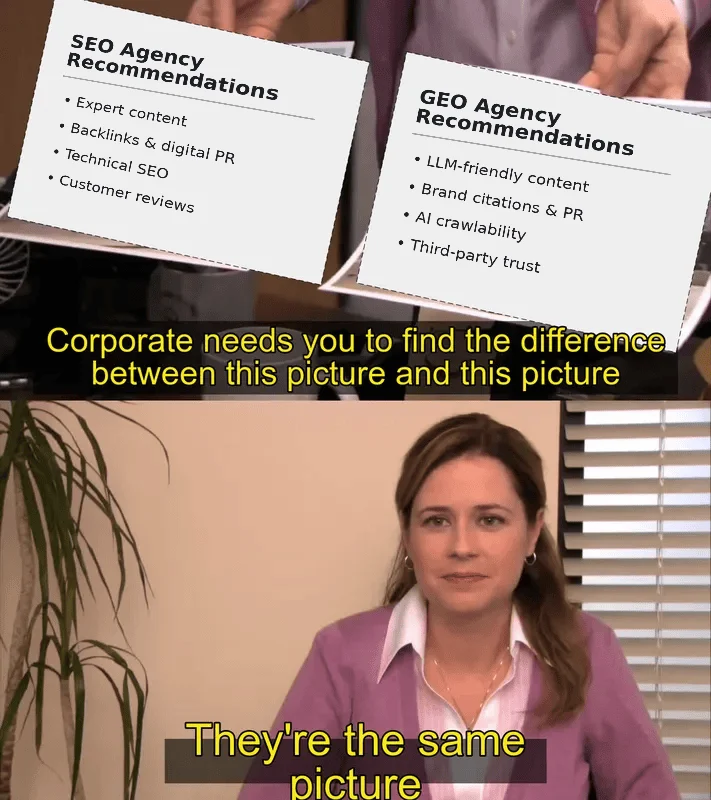
That's why I find it strange when GEO gets treated as a completely separate marketing strategy.
A lot of the work overlaps with things good marketing teams should already be doing.
And figuring out which activity contributed to which result is another headache.
Gamma is a good example of how messy attribution can get
Ravish Agrawal, Gamma's Head of Growth Marketing, shared some interesting details in his interview with StackedGTM.
Gamma has invested in improving how the product appears in AI-generated answers.
Some of that work includes publishing pages designed for AI retrieval.
But a significant part of its effort has also involved getting represented in external sources.
Reddit discussions, comparison articles, and other websites that AI systems were already referencing.
That alone tells us something.
Improving AI visibility can involve work outside your own website.
Now, the part that caught my attention was how Gamma measures acquisition.
They added an option to their signup survey allowing people to indicate that they discovered Gamma through an AI assistant.
Simple enough.
But it helped them identify users who had previously been counted as Direct traffic.
And here's another detail.
Gamma hasn't run a clean holdout experiment to establish how many additional customers AI discovery actually generated.
Agrawal describes their results as attributed acquisition.
He also mentions seeing AI citation charts increase without any corresponding movement in signups.
I appreciate that level of transparency.
Because that's exactly the kind of thing we need to discuss more often.
Imagine you're presenting a report showing that AI visibility increased by 40%.
Great.
But signups haven't changed. Pipeline is flat. Revenue hasn't moved.
What now?
Do we celebrate the visibility increase?
Do we immediately recommend another batch of articles?
I'd want to investigate what happened before deciding anything.
Maybe we're appearing in prompts that aren't relevant to our ICP.
Maybe buyers are encountering our brand but choosing competitors.
Maybe we're influencing awareness, and the impact won't be visible until later.
Or perhaps those additional citations simply aren't generating meaningful business results.
We can't know which explanation is correct from citation share alone.
The attribution problem nobody can completely escape
Let's use our compliance software company again.
Someone asks ChatGPT to recommend enterprise compliance platforms.
Your company appears in the response.
The person visits your website, reads about the product, and leaves.
Two weeks later, they search for your company on Google.
They return, request a demo, and eventually become a customer.
Now, which channel gets credit?
Depending on your attribution model and what was actually tracked, the answer could be different.
And that's the problem.
We can attribute conversions to specific interactions, but that doesn't automatically tell us whether those interactions generated additional business.
For GEO, we're still figuring out how to establish those relationships reliably.
And with enterprise B2B companies, things get even more complicated.
You're dealing with long sales cycles, multiple stakeholders, and people researching products across different platforms.
Someone might discover a product through ChatGPT, read customer reviews, visit the website several times, attend a webinar, and eventually speak with sales.
How much of that deal should be credited to AI discovery?
I don't have a perfect answer.
And I'd be skeptical of anyone claiming they do.
Sometimes even the tracking changes
Here's a pretty good example of why we need to be careful.
On October 15, 2026, Search Engine Land reported that ChatGPT appeared to have stopped passing certain tracking information, potentially causing visits from ChatGPT to be classified as Direct traffic.
Adobe's Cedric Huesler examined approximately 500 pages where ChatGPT had previously accounted for at least 5% of traffic.
Comparing October 9 to 13 with the preceding week, the analysis found:
- ChatGPT referrals dropped by approximately 31,000 visits per day.
- Direct traffic increased by around 26,000 visits per day.
- Two-thirds of the pages losing ChatGPT referrals also experienced an increase in Direct traffic.
Now, did people suddenly stop visiting those websites through ChatGPT?
We don't know.
The findings suggest that some visits may have been recorded as Direct traffic instead. At the time of reporting, OpenAI hadn't confirmed the cause.
But imagine you're presenting your monthly GEO report.
Your analytics show a significant decline in ChatGPT referrals.
Your client wants to know what happened.
Should you recommend more content? More citations? Another round of optimizations?
What if nothing actually changed in how people discover your business?
What if the tracking changed?
That's why I'd want to look at several metrics before making a recommendation.
For example:
- Are AI referrals increasing or decreasing?
- Is Direct traffic changing at the same time?
- Are visitors converting into qualified leads?
- Are prospects mentioning AI assistants during signup or sales conversations?
- Are those leads becoming actual opportunities?
I'd also want to understand whether our tracking setup or attribution methodology had changed.
We might not have perfect attribution, but at least we're working with more than one piece of evidence.
And if the evidence isn't strong enough to explain a change, we should be comfortable saying that.
Okay, but what would I actually recommend?
First, I'd stop treating every GEO visibility gap as something that requires an immediate content recommendation.
If I'm working with a company, I want to understand its business before proposing a bunch of initiatives.
What does the product do? Who buys it? Why do customers choose it? What problems are we actually solving?
Then I'd review the GEO data.
I'd look at the prompts we're monitoring, where competitors appear, and how AI systems describe the brand.
And I'd compare those observations with what we already know from customer research, CRM data, and sales conversations.
Let's say we discover that our brand appears regularly in relevant prompts, but the product is consistently described as a cheaper alternative to competitors.
Meanwhile, our positioning is focused on security, reliability, and enterprise capabilities.
That's worth investigating.
Why is there a disconnect?
Are third-party websites describing us that way?
Is our own messaging unclear?
Are we targeting prompts that don't represent our actual buyers?
Maybe there's an opportunity to improve our positioning. Maybe we need stronger customer evidence or more relevant third-party coverage.
We can develop a hypothesis, decide what to test, and establish how we'll evaluate the results.
I wouldn't change the homepage, publish ten articles, launch a podcast, and start a digital PR campaign all at once.
Then, three months later, point to a visibility increase and claim our strategy worked.
How would we know which changes contributed?
I'd rather start with a specific problem and test a reasonable solution.
Some experiments won't work.
Others might improve metrics outside GEO.
And that's fine.
If we're investing in customer research or improving product messaging, I wouldn't consider the investment wasted just because our citation share didn't increase.
Those activities can improve other parts of the business.
Of course, if the objective is specifically to improve AI visibility, we still need to assess whether we're making progress toward that objective.
But reducing the entire value of a marketing investment to one GEO metric seems shortsighted.
There's No Magic GEO Playbook
I think the GEO industry has a lot of room to grow.
The tools are improving, and we're getting better at understanding how people discover brands through AI systems.
There are legitimate technical problems to solve and plenty of opportunities for companies willing to experiment.
But I'd be careful with anyone selling a universal GEO playbook.
Especially when the proposal looks almost identical regardless of the company, industry, or target audience.
If you're evaluating an agency or consultant, I'd want them to explain a few things.
- Why are these specific initiatives relevant to our business?
- What evidence suggests they might work?
- How are we going to measure the results?
- What happens if the experiment doesn't produce the expected outcome?
- Could these investments also improve other parts of our marketing and sales process?
I don't expect someone to guarantee the results.
Actually, I'd be more concerned if they did.
GEO is still developing, and we have a lot to learn about how AI visibility translates into business outcomes.
What I do expect is someone who understands the limitations of the available data and can make reasonable recommendations based on it.
If that means starting with customer research instead of publishing another 20 articles, so be it.
If it means improving product messaging before worrying about HTML tables, that's fine too.
And if the data suggests we're already performing well enough in AI visibility but have a conversion problem, then maybe that's where our attention should go.
For me, GEO should be approached as part of a broader marketing strategy.
One where we understand how different activities contribute to brand discovery, customer acquisition, and business growth.
Because you can have the most beautiful GEO dashboard in the world.
But if nobody is buying your product, I'd probably start asking questions about something other than your citation share.
Sources & References
- PMMs are feeling the research squeezehttps://productmarketer.substack.com/p/pmms-are-feeling-the-research-squeeze
- AI Search Attribution: Connect Citations, Brand Discovery, Website Visits, and Revenuehttps://topify.ai/blog/ai-search-attribution
- StackedGTM Operator Series: A conversation with Ravish Agrawalhttps://newsletter.stackedgtm.ai/p/stackedgtm-operator-series-a-conversation-with-ravish-agrawal
- ChatGPT drop in UTM tracking was a bughttps://searchengineland.com/chatgpt-appears-to-drop-utm-tracking-making-ai-referral-traffic-harder-to-measure-496552