
I’ve worked with B2B agencies at two pretty different ends of this conversation.
One was built around tiers and organic content. The owner cared about people and understanding processes, but the way we set goals, measured progress, and connected the work to pipeline felt slow and, honestly, not very developed.
The other worked with early-stage startups. Its owner was so focused on pipeline and automation that he changed how the agency worked. It became much more of a system, with AI agents handling large parts of the operation and people concentrating on specific decisions, explanations, and insights.
Both were established businesses with years of experience. I’m not saying either was incompetent.
But having experienced both, I do wonder how much work companies will keep paying agencies to handle when they can do more of it themselves.
Are AI agents already taking over agency contracts? And if you own an agency, what should you actually change?
AI agents are already taking on some agency work
In November, Kyle Poyar shared how incident.io built an agent to handle its paid campaigns. Its CMO reported replacing agency work and reducing ABM campaign setup from two or three days to three minutes.
Those are the company’s own claims. Faster setup doesn’t prove better revenue results, and one company doesn’t tell us what happens to the whole industry.
But I wouldn’t dismiss it, either.
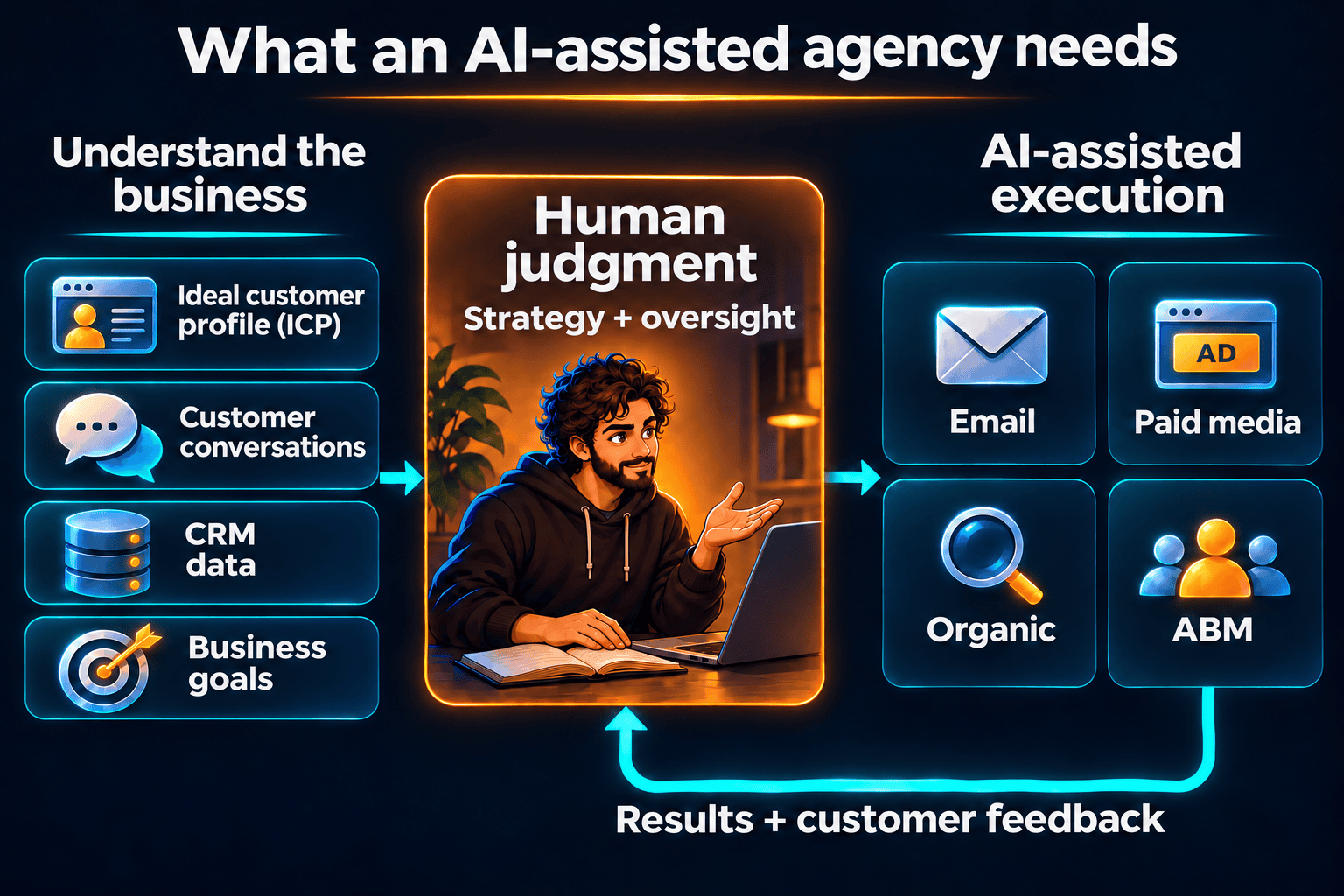
What caught my attention was everything the agent had access to: approved messaging, CRM information, intent signals, and attribution. A human also reviewed its proposed improvements.
That matters. You can’t look at the three minutes and forget the business knowledge that made those three minutes useful.
A package can be the wrong answer. So can an agent.
My problem with tiers is that you’re deciding what the client needs before you understand the business.
Maybe organic is already working. They have traffic. What they don’t have is people asking for a demo, and you haven’t figured out why. It could be the messaging, the offer, or the kind of people landing on those pages.
So why the fuck are you selling them more articles?
You can complete the package perfectly and still leave the client with the same problem.
The research suggests clients want more help thinking through those decisions. In July 2026, the IPA and Tracksuit surveyed 200 senior client decision-makers about what they value in an agency relationship. Growth thinking mattered to 83%, but only 48% felt they were getting it.
They valued production quality, too. This isn’t permission to sell strategy and deliver crap.
An automated agency can miss the business just as easily. You can have AI agents producing content, sending emails, running paid campaigns, and building ABM lists without understanding where the client actually needs help.
Maybe organic is already doing its job. The problem could be what happens after someone submits a form, how the team follows up by email, or whether the accounts you’re targeting are even a good fit. You have to look at the CRM and talk to sales to understand that.
That’s my concern with handing the whole operation to AI agents. You can get very good at running the plan without asking whether the plan needs to change. If the opportunity is in another channel, somebody has to notice and be willing to move the effort there.
What I would change as an agency owner
I wouldn’t start by adding “AI-powered” to the website. I’d look at the team, the clients we understand best, and how we decide what to sell them.
Get the whole team comfortable working with AI
Your writer might hate using AI to produce content. Fine. She should still understand how it works, where it gets things wrong, and how to make something useful with it.
And you need someone who can maintain and fix your AI agents. Relying on a system nobody on your team can explain would make me nervous.
BCG’s June 2026 research, including a survey of 300 CMOs across B2B and B2C, points to data foundations and talent as important parts of AI transformation. That’s a bigger job than handing everyone a subscription.
Here’s how I would think about the team:
| What you need | What that person or team should actually do |
|---|---|
| AI literacy | Understand the tools, check their claims, and know when the output needs more context or human attention. |
| Someone owning automation | Connect tools, monitor failures, manage access and costs, and fix things when they break. |
| Someone improving content production | Work on sources, prompts, instructions, and checks so the same problems stop appearing in every draft. |
| Human strategy and creativity | Listen to customers, challenge the brief, develop ideas, and decide what is worth trying. |
That doesn’t mean hiring four people. It means knowing who is responsible.
Tell the client where you use AI, what needs their approval, and how you handle their data. They should also know who to contact when something goes wrong. Those are reasonable questions to answer before selling the system.
The content role is particularly interesting to me. If you keep editing the same bullshit out of every article, go back and investigate why it keeps appearing. Is the source material weak? Are the instructions wrong? Is customer context missing?
That is where content becomes an engineering problem as well as an editorial one.
Give the team time to learn this together. Making people responsible for AI without training them is a pretty unfair way to “transform” an agency.
Focus on the industry where you can show results
If you’ve worked with manufacturers, startups, and consumer brands, but your best work is in manufacturing, maybe that’s the lane you should take seriously.
You already understand things a new agency would have to learn. Use that.
Promethean Research’s April 2026 report found that industry specialists with a broad service mix grew four times as fast as pure generalists in 2025. That’s survey-based evidence of a pattern, not a guarantee that picking an industry makes you successful.
The report also found strong results among agencies cutting services. So don’t read this as advice to keep adding things to the menu.
Look at where you have results, repeat clients, decent margins, and real knowledge. Build around that. Keep an eye on how dependent you become on one industry, especially if its business swings heavily with the economy.
Start with an audit, then build the strategy and price it
I’d rather start by understanding what the client does, what they’ve tried, what works, and what doesn’t.
Charge for that work. You’re investigating where they should put their money.
Then build the strategy and decide what delivering it requires.
| Step | What you work out | What the client gets |
|---|---|---|
| Audit | Customers, existing activity, results, gaps, and constraints | A clear view of what needs attention |
| Strategy | Priorities, channels, experiments, and measures of success | A plan with reasons behind it |
| Scope and price | Work involved, people, tools, automation, and responsibilities | An agreement tied to the plan |
| Review and improve | What happened, what changed, and what needs fixing | Adjustments based on evidence |
This is why I’m uncomfortable with hours or tiers being the starting point. They tell the client how much activity they can buy before we’ve established which activity matters.
You can still use a fixed fee or retainer. Define the scope, include maintenance, and agree on when the plan should change. If payment depends on results, be clear about attribution and what the agency can actually control.
Look beyond the channel you happen to sell
Knowing an industry should help you spot opportunities across its buying process.
Maybe organic is doing its job, but email needs attention. Maybe paid media could help reach the right accounts. Maybe sales needs better customer stories.
You don’t have to deliver everything yourself. Bring in people who can help, and be honest about who owns each part.
Producing content gets easier. Understanding what helps someone choose you, and earning their trust, still takes work.
That’s why I’d keep customer conversations close to the team. Search metrics are useful, but they shouldn’t be the only thing deciding what gets made.
So, are agencies doomed?
I don’t think so. Some work is already being taken in-house with AI agents, and I’d take that seriously. I also wouldn’t assume that adding more AI agents protects your contracts.
You need to know what they should do, how to maintain them, and who steps in when they fail. Start with work you understand and expand after you’ve seen the results and costs.
The product marketing teams that impress me still rely on people’s critical thinking and creativity. AI helps them research, produce, and explore. The interesting ideas still need someone willing to question them and make a decision.
Having worked with both agency models, that’s what I’d look for: people who understand the business, can use the technology, and can explain why their work deserves the client’s money.
Sources & References
- 5 GTM plays working right nowhttps://www.growthunhinged.com/p/5-gtm-plays-working-right-now
- New IPA/Tracksuit report reveals what clients want from their agencieshttps://ipa.co.uk/news/bridging-the-gap
- Moving the Agentic Marketing Transformation from Illusion to Realityhttps://www.bcg.com/publications/2026/making-the-agentic-marketing-transformation-a-reality
- 2026 Digital Agency Industry Reporthttps://prometheanresearch.com/wp-content/uploads/2026/04/2026-Promethean-Research-Digital-Agency-Industry-Report.pdf