
A while ago, I started building what was basically an AI GTM strategist.
The idea was simple: give it enough information about a company and let it handle a lot of the painful work behind strategy:
- Research the market
- Analyze competitors
- Find signals
- Suggest experiments
- Generate hypotheses worth testing
I tested it with a couple of startups.
Technically, it worked.
Strategically, some of the first outputs were crap.
The AI could research just fine. What it didn’t have was context.
I had to explain the products, ICPs, value proposition, how customers used the product, what had already been tried, and what actually mattered commercially.
Once I did that, it became much more useful.
It could spend hours going through competitors, customer conversations, market signals, and other sources, then connect that research with what I already knew about the business.
So yes, the automation worked.
But it wasn’t AI doing strategy on its own.
It was me doing strategy with a machine that could research much faster than I could.
Otherwise, we’re basically congratulating the machine for the judgment we quietly gave it behind the curtain.
Key takeaways
- AI is making GTM execution dramatically cheaper.
- Buyers want more autonomy, but they still turn to people for context, validation, and confidence.
- The goal isn’t to keep everything human. It’s to protect the parts where judgment matters.
- More output isn’t automatically better GTM. Sometimes it’s just more shit for people to ignore.
AI is working. So are most human channels.
The 2026 State of B2B GTM report surveyed 300 software GTM leaders.
Some of the findings look strange next to each other:
| GTM signal | Finding |
|---|---|
| Teams reporting big GTM impact from AI | 43%, up from 24% |
| Network and introductions as a core channel | 62% |
| SEO as a core channel | 51% |
| Founder/employee LinkedIn as a core channel | 50% |
| Planning more investment in AI search | 50% |
| Planning more investment in signal-based outbound | 48% |
Cold outreach landed in the oversaturated part of the report. Intimate events ranked among the strongest channels.
So AI is getting better while some of the strongest channels still involve people actually talking to other people.
Terrible news for anyone hoping to automate the entire revenue organization from a Clay table and call it a day.
But this isn’t humans beating AI.
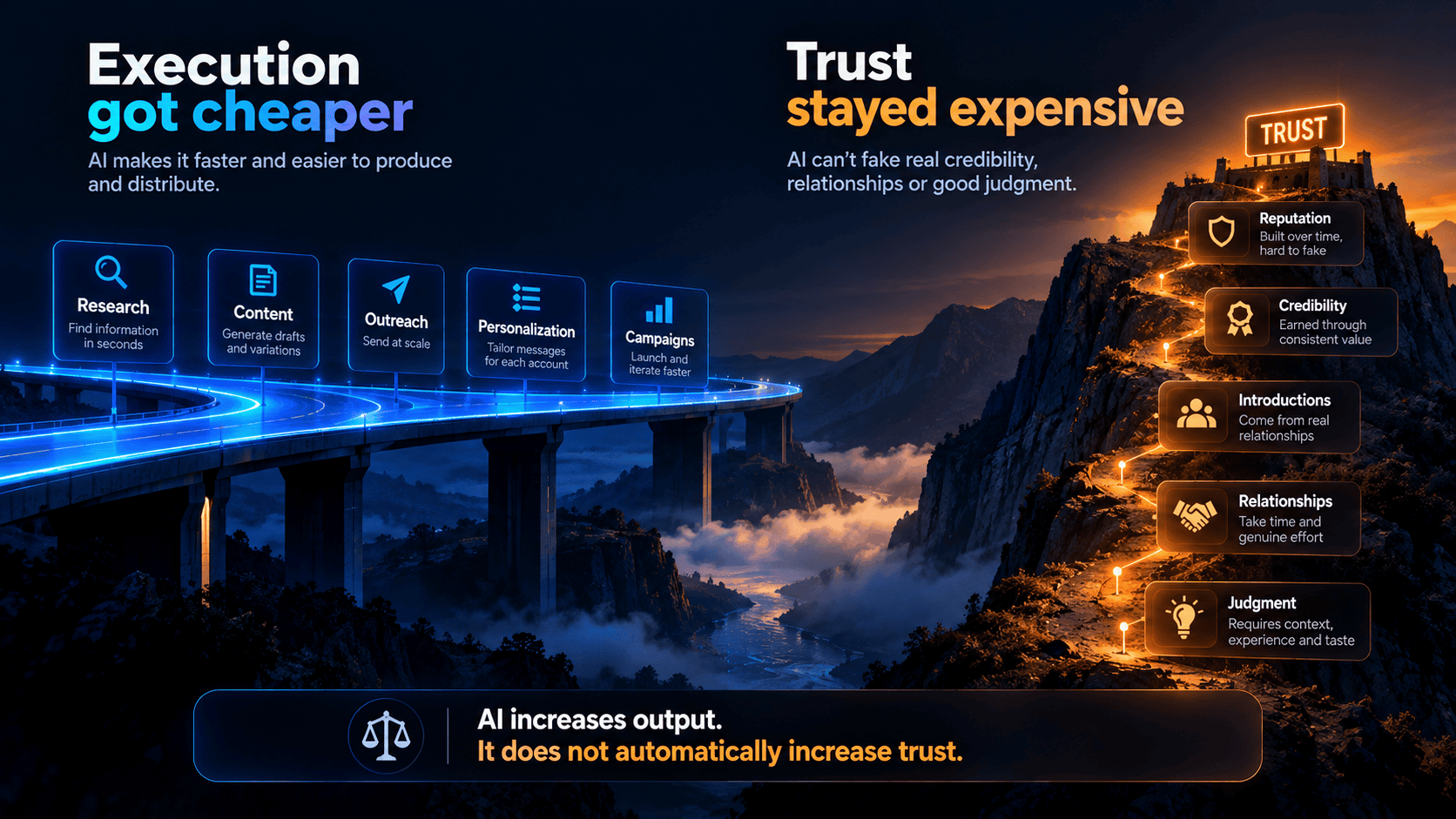
AI made GTM execution cheap. Trust is still expensive.
Research, analysis, drafting, personalization, and finding another 500 accounts are all cheaper.
Judgment isn’t.
Neither are credibility, reputation, relationships, or knowing whether you actually have something worth saying.
Buyers don’t need more information. They need confidence.
Gartner’s research found:
- 67% of B2B buyers prefer a sales-rep-free experience.
- 70% prefer a fully digital, self-service experience.
- 69% prefer a sales rep when validating AI-generated insights.
Those came from separate questions, so the groups overlap.
The useful part is the behavior behind them.
Buyers can compare vendors, read reviews, watch demos, research pricing, and ask an AI assistant before they ever talk to sales.
What becomes more valuable as uncertainty increases is context.
Gartner’s recommendation is basically to stop inserting sellers everywhere and use them where they can add something buyers can’t easily get themselves: validation, risk reduction, and confidence.
That’s a better use of a salesperson than reading the damn website back to someone on a discovery call.
The trust battle starts before sales shows up
According to its buyer study, 6sense found that 94% of buying groups had already ranked their shortlist before engaging sellers.
Buyers initiated first contact 79% of the time, and the preferred vendor won in nearly 80% of cases.
That doesn’t mean content or networking caused those wins.
It means preference forms early.
Before an SDR shows up, the buyer may already have been influenced by:
- A founder they’ve followed
- A colleague who recommended you
- An article that helped them understand the problem
- Customer reviews
- A conversation at an event
- Previous experience with your product
By the time your sequence arrives, you’re often joining a conversation that’s already been happening without you.
Which makes:
“Hey John, noticed you’re VP of Marketing at Acme…”
even more tragic.
Yes. Congratulations. LinkedIn noticed too.
Getting an answer is cheap. Believing it isn’t.
TrustRadius surveyed 1,862 technology buyers and found that 63% had used AI somewhere in their buying process.
Among buyers who used AI for purchase research, 94% fact-checked it at least some of the time.
And 74% used customer reviews during the purchase process.
AI usage is becoming normal.
Blind trust in AI isn’t.
Getting an answer is becoming cheap. Believing the answer isn’t.
The problem isn’t AI-written outreach. It’s fake relevance.
I don’t buy the idea that every sales email needs to be lovingly handcrafted by a human staring thoughtfully out a window with artisanal coffee.
Nobody gives a shit.
Firmable surveyed 1,009 professionals about cold outreach:
- 58% said relevance or genuine value mattered most when deciding whether to reply.
- Only 13% prioritized whether a human wrote the message.
A relevant AI-assisted email can beat a useless human-written one.
The problem starts when AI manufactures the appearance of relevance.
“Congrats on your Series B.”
“Saw your recent LinkedIn post.”
“Noticed you’re hiring.”
Yes. You and the other 300 robots.
That’s not personalization.
That’s a mail merge wearing a fake mustache.

LinkedIn is seeing the same problem with content. AI-assisted writing is fine. Generic, repetitive content with no real point of view is what the platform is trying to reduce.
The problem isn’t AI.
It’s having nothing interesting to say and suddenly gaining the ability to say the same boring shit at industrial scale.
So what should GTM teams actually do?
The useful question isn’t whether GTM should be AI-led or human-led.
It’s where each one should do the work.
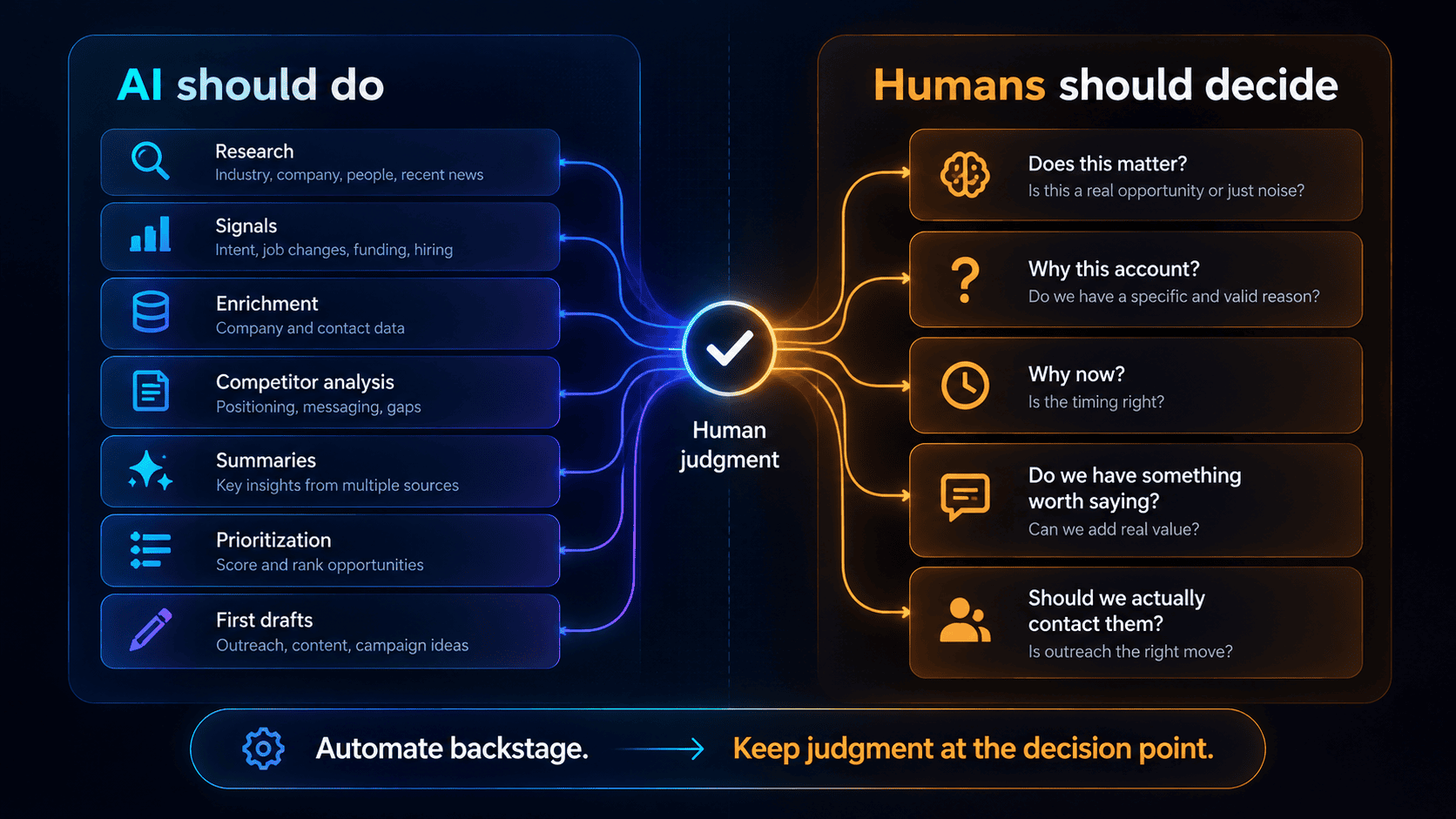
1. Automate the research before the relationship
Push AI hard backstage:
- Research
- Enrichment
- Competitor analysis
- Signal detection
- Summaries
- Prioritization
- Call preparation
- Hypothesis generation
Then keep one simple checkpoint:
Do we actually have a reason to talk to this person?
AI can help find relevance.
It shouldn’t invent relevance because somebody promised the VP of Sales another thousand prospects this month and everyone is now pretending that’s a strategy.
This is also why I think you should first ask whether the problem actually needs an AI agent before building one.
Automating confusion just gives you confusion faster.
2. Stop treating relationships like luck
If introductions are one of your strongest channels, build a system around getting more of them.
Not a cursed “friendship automation funnel.”
Please don’t build that.
Instead:
- Know which customers are willing to introduce you.
- Map warm paths into important accounts.
- Create smaller events where customers and prospects can actually talk.
- Build customer advocacy into GTM.
- Help founders and subject-matter experts publish things worth following.
- Keep relationships alive before the pipeline goes to hell and everybody suddenly remembers referrals exist.
Relationship-driven GTM doesn’t have to mean unstructured GTM.
3. Put humans where they can change the decision
Don’t spend expensive human time doing something a buyer can handle in ten seconds.
Nobody needs an AE to read a feature list.
They might need:
- An AE who understands their weird implementation problem
- A customer who can explain what implementation was really like
- A founder who can explain why the product works differently
- An expert who can challenge their assumptions
- Someone credible enough to say, “No, I don’t think we’re a good fit”
Sometimes the most trustworthy thing a salesperson can do is tell somebody not to buy.
Those are the moments where judgment changes confidence.
That’s where humans belong.
Not everywhere.
Where they matter.
Trust is still expensive
AI gives GTM teams a ridiculous amount of leverage.
That’s good.
But there’s another problem hiding behind that productivity.
According to its B2B marketing research, 87% of marketers using AI for content creation reported improved productivity.
Only 39% reported better content performance.
That’s a pretty big damn gap.
So what happens when every hour AI saves becomes:
- Another campaign
- Another article
- Another outbound sequence
- Another experiment
- Another deliverable nobody asked for until AI made it possible
“We can produce twice as much now” quickly becomes “Great, produce twice as much.”
And somewhere in that equation, nobody asks whether twice as much crap is actually an improvement.
We may be getting extremely good at scaling execution.
I’m not convinced we’re scaling judgment at the same rate.
And I suspect that’s the bigger problem.
Sources & References
- The 2026 State of B2B GTM: What the Companies Are Betting Onhttps://knowledge.gtmstrategist.com/p/2026-state-of-b2b-gtm-report
- Gartner Survey Finds 69% of B2B Buyers Turn to Sales Reps to Validate AI-Generated Insightshttps://www.gartner.com/en/newsroom/press-releases/2026-05-20-gartner-survey-finds-sixty-nine-percent-of-b-two-b-buyers-turn-to-sales-reps-to-validate-ai-generated-insights
- The B2B Buyer Experience Report for 2025https://6sense.com/science-of-b2b/buyer-experience-report-2025/
- Keeping conversations real on LinkedInhttps://news.linkedin.com/2026/keeping-conversations-real-on-linkedin
- Beyond the Hype: The AI Bubble that Isn't Bursting (Yet)https://www.trustradius.com/blog/beyond-the-hype
- The cold outreach pulse reporthttps://firmable.ai/au/resources/blog/the-cold-outreach-pulse-report/
- Faster and Cheaper, But Not Better: What the 2027 B2B Content and Marketing Trends Report Reveals About AI, Speed, and Trusthttps://contentmarketinginstitute.com/b2b-research/b2b-content-marketing-trends-research