
Table of contents
1. I learned this the embarrassing way
2. AI doesn't make us dumb. It makes skipping validation cheap
3. The real scarce resource is judgment
4. AI slop is a customer empathy problem
5. The problem starts upstream
6. Developers inherit the consequences
7. More output does not mean less work
8. What responsible AI use actually looks like
9. Use AI for leverage, not permission
I learned this the embarrassing way
A few months into using frontier AI models heavily for work, I caught myself doing something I now hate.
I was trusting it.
Not “using it.” Trusting it.
At one agency I was suddenly handling five or six accounts. Research, execution, reporting, experiments, client context, all of it. I had not been properly onboarded into every account, but the expectation was still simple: move fast and show results.
AI felt like the obvious solution.
Research got faster. Reporting got faster. I could turn messy notes into something presentable in minutes. I could ask a model to summarize a market, interpret a dataset, draft a recommendation, then jump to the next account.
It worked until it didn't.
Small hallucinations started slipping through. A number that looked plausible but was wrong. A conclusion that sounded confident but came from incomplete context. An assumption about a client that I had not actually validated.
Some of those mistakes were caught internally. A couple reached clients.
I was fucking embarrassed. But it also changed how I use AI.
The lesson was not that AI is useless. If anything, I am more capable because of it. I can research faster, build things I could not build before, automate repetitive work and move from an idea to a prototype ridiculously quickly.
The lesson was simpler:
AI makes it very easy to confuse speed with judgment.
And when the workload gets heavy enough, that distinction gets blurry fast.
AI doesn't make us dumb. It makes skipping validation cheap
This is why I am not particularly interested in the “AI is making everyone stupid” argument.
That is too easy.
The more interesting problem is that AI lowers the cost of skipping uncomfortable parts of knowledge work.
Thinking through a messy problem is uncomfortable.
Sitting with incomplete information is uncomfortable.
Talking to customers until your original idea falls apart is uncomfortable.
Checking the same number twice is boring.
AI can remove a lot of that friction. Sometimes that is exactly what we want. I do not need personal growth from manually cleaning a CSV.
But not all friction was waste.
Sometimes the friction was the part where we thought.
More recent Microsoft Research points to a slightly different problem. In a January 2026 experiment on AI-assisted writing, researchers found that adding an assumption check reduced overreliance without increasing cognitive load. Their broader Tools for Thought work makes the point even more bluntly: AI should challenge, not just obey.
That distinction matters.
AI can help you think. It can also make it incredibly easy to stop questioning.
The problem begins when “give me a second opinion” turns into “tell me what to think.”
The real scarce resource is judgment
An email I got today made a point I keep coming back to: once everyone has access to powerful AI tools, access stops being the advantage.
The advantage becomes orchestration and judgment.
That feels right.
Everyone can generate ten campaign ideas now.
Everyone can generate a landing page.
Everyone can generate a product concept, a video storyboard, a content brief, an app prototype or 500 lines of code before lunch.
Creating options is cheap.
Choosing well is not.
There is newer research that makes this tension even more interesting. A 2026 study in Computers in Human Behavior: Artificial Humans found that GenAI can improve creative performance while still pushing outputs toward similarity. The researchers also found that using diverse AI personas helped mitigate that homogenization. AI can raise the floor, but defaulting to the same model behavior can narrow the range of ideas.
Individually, people improved.
Collectively, the ideas got narrower.
That is a useful warning for anyone doing creative or strategic work.
AI can raise the floor while quietly pulling us toward the middle.
If everybody asks similar models the same vague question, “what should I write?”, “what campaign should we run?”, “what should I build?”, we should not be surprised when a lot of the answers feel familiar.
Taste becomes more valuable precisely because generation is abundant.
AI slop is a customer empathy problem
Most conversations about AI slop focus on how it sounds.
Too many weird transitions.
Words nobody says out loud.
The tone of someone who somehow became an expert on every subject five seconds ago.
The endless “not X, but Y” constructions.
And, yes, enough dashes to build a suspension bridge.
Those are symptoms.
The bigger problem is that the output often comes from nowhere real.
You can give an AI your website. You can upload a positioning document, an ICP definition and a brand guide.
That still does not necessarily tell it what your customer actually feels.
An ICP document might say:
VP of Marketing. B2B SaaS. 100 to 500 employees. Responsible for pipeline.
A sales call might say:
“I don't need another dashboard. I need to know why our pipeline disappeared this quarter before my CEO asks me again.”
Those are not the same kind of information.
The second one contains anxiety, priorities, language, internal politics and context. That is the stuff good marketing is made of.
AI can analyze thousands of sales transcripts and surface patterns better than I ever could manually. That is a fantastic use of AI.
But asking it to invent the pain point from a persona document is different.
That is where plausible nonsense starts.
My quality check for content has become pretty simple:
Does this answer a real need for the ICP?
And after they read it, does anything change?
Do they understand the problem differently?
Do they see the product differently?
Do they trust the brand more?
If the answer is no, the article can be factually perfect and still be noise.
This is also why my own experiments with AI-built tools have become more deliberate. I've built a topical map or two with AI, but the useful part still depended on me deciding what good clustering looked like, which false positives mattered and when the output was bullshit. The tool was not the ceiling. My judgment was.
The problem starts upstream
This gets more interesting when you move from individual work to organizations.
Sometimes the sloppy part starts before anyone opens ChatGPT.
It starts with a question like:
“What is our AI strategy?”
Or:
“Our competitor launched an AI feature. What are we doing?”
There is nothing inherently wrong with either question.
The problem is when “use AI” becomes the goal instead of a constraint or capability.
Now Product has to find a use case.
PMM has to find a reason the customer should care.
Engineering has to find a way to build it.
Marketing has to find a way to explain it.
Everyone downstream can do competent work and still end up executing a premise nobody properly validated.
A recent Product Marketing discussion described exactly this tension. A founding PMM at a B2B SaaS company wrote about repeated AI launches and repositioning efforts where the actual product did not solve the problems the messaging claimed it solved. The pressure, according to the post, was to stay relevant.
That is anecdotal. It does not mean every AI feature is useless.
But it captures a pattern worth paying attention to:
AI makes bad premises executable faster.
Before cheap prototypes and AI-assisted development, a weak idea at least had to survive the cost of building it.
That barrier is disappearing.
This is good. I would rather live in a world where more people can build.
But it also means “we can build this” is becoming a terrible reason to build something.
Developers inherit the consequences
This is also why I think developers get blamed for the wrong part of the problem.
If a bad AI feature ships with bugs, it is easy to point at the code.
But the developer may be the least interesting person in the chain.
Who decided the feature needed to exist?
What customer problem justified it?
How quickly did leadership expect it shipped?
How many other projects was that team handling?
AI coding tools can make developers dramatically faster. They can also increase the volume of code that needs to be reviewed, tested and maintained.
Stack Overflow's 2025 Developer Survey captures the weird contradiction. Most developers are using or planning to use AI tools, yet trust is much lower. Sixty-six percent said one of their biggest frustrations is AI output that is “almost right, but not quite,” and 45% said debugging AI-generated code can be more time-consuming.
That sounds familiar outside engineering too.
The first draft is cheap.
The last 20% is where reality shows up.
And when management sees the first 80% getting faster, the natural temptation is not always “great, everyone has more breathing room.”
Sometimes it is:
“Great. Do more.”
More output does not mean less work
This is where the productivity story gets messy.
Newer 2026 data makes the tradeoff much clearer. BairesDev's Q3 2026 Dev Barometer surveyed 705 developers across more than 60 countries. Developers reported saving 13 hours a week on coding, but 67% now spend more time reviewing AI-generated code, 52% more time debugging AI-introduced problems, and 60% said catching subtle AI bugs takes more mental effort.
The ILO's June 2026 review of empirical evidence reaches a broader conclusion: productivity gains are real but uneven, and reported time savings have not consistently translated into higher measured output, earnings or employment.
Upwork's 2026 Future Workforce Index points to where value is moving instead. Lower-complexity AI execution work grew fast while earnings declined, while AI-augmented professional services grew 72% year over year and earnings rose 22%.
Upwork calls the higher-value role an AI orchestrator: someone who combines AI fluency with domain expertise, judgment, workflow design and business context.
That sounds less like AI replacing work and more like judgment moving up the stack.
It sounds like work moving downstream.
- Generate faster.
- Review more.
- Ship more.
- Fix more.
Repeat.
This is the part I missed when I first started relying too heavily on AI.
I thought delegation meant the model owned the outcome.
It does not.
If my name is on the report, I own the report.
If your team ships the feature, your team owns the feature.
AI can execute tasks. Accountability does not transfer with the prompt.
What responsible AI use actually looks like
I use more AI now, not less.
The difference is that I make it earn trust.
A wise leader I spoke with recently put it in a way that stuck with me: AI is a great coworker, but a very, very sloppy one.
I think that's exactly right.
If you don't care about the outcome, you can give AI a task, take the first answer and move on. If you do care, you have to stay involved. Correct it. Show examples. Point out what it missed. Push back when the answer is generic. Repeat until it starts learning the pattern you actually want.
Honestly, it feels a little like raising a digital child. You would not expect a kid to master something from one explanation. Why would you expect a model in a chat window to understand your taste, your customer, your brand voice and your quality bar on the first attempt?
This article is a pretty good example. The first draft was not bad. But it took several rounds of feedback on links, anchor text, source freshness, structure, tables, formatting and tone to get it closer to what I actually wanted. That is not proof that AI is useless. It is proof that good output still needs guidance.
My rule now is simple: understand before you automate. If I cannot explain the business goal, the ICP, the product, the constraints, the data source and what a good outcome looks like, I have no business handing that shit to an agent and hoping for the best.
How I use AI now
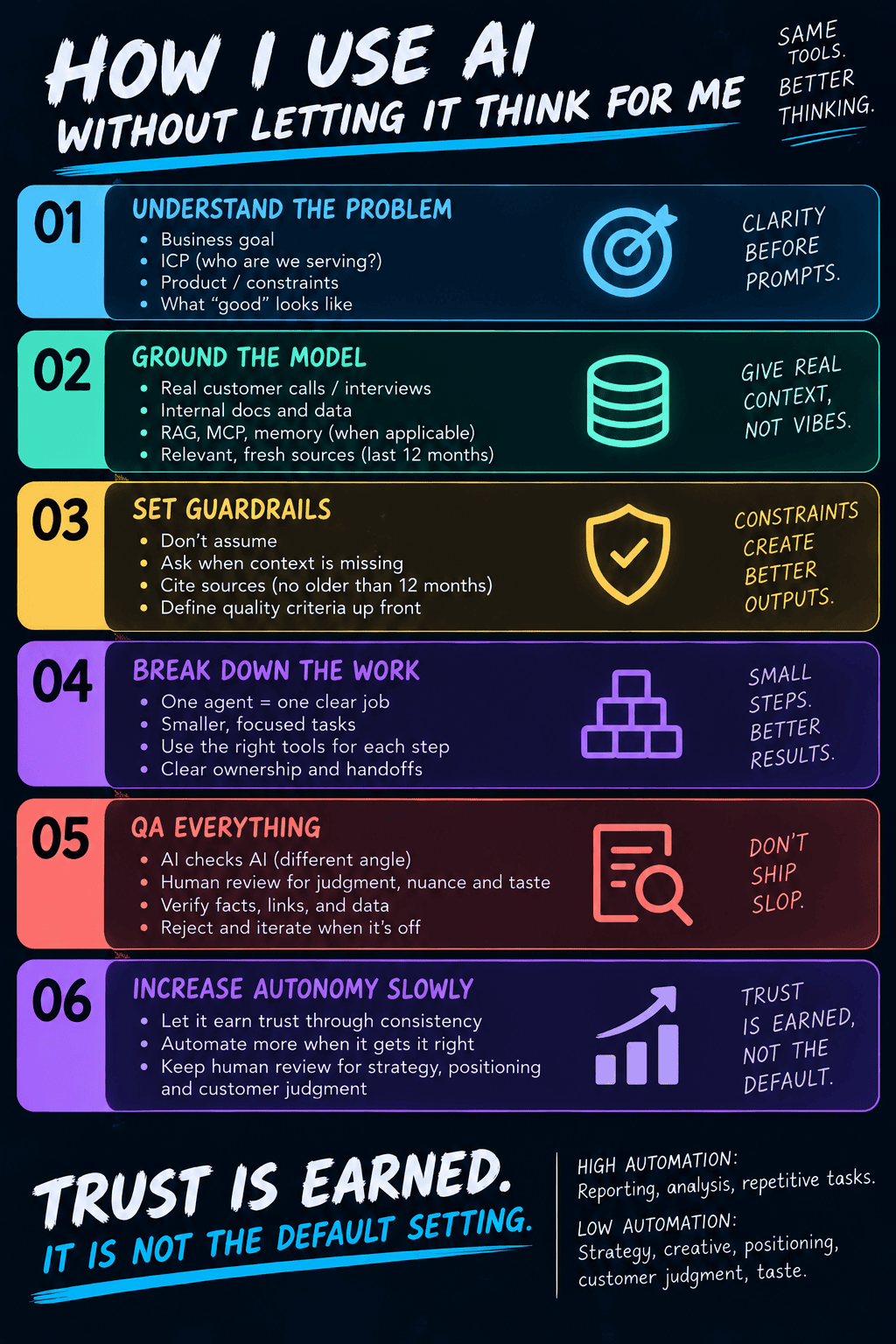
| Step | What I do | Guardrail |
|---|---|---|
| 1. Understand first | Map the business goal, ICP, product, lifecycle, constraints and what success looks like. | If I cannot explain it myself, I do not automate it. |
| 2. Ground the model | Feed it real context: customer calls, docs and trusted data through RAG, MCP, vectors or memory when needed. | Do not let the model invent customer pain. |
| 3. Constrain it | Set explicit rules on assumptions, sources and missing context. | If something material is missing, ask instead of guessing. |
| 4. Split the work | Give narrow subagents one job each instead of asking one giant agent to do everything. | Smaller scopes are easier to evaluate and debug. |
| 5. Define quality | Show examples of what good looks like, including brand voice, expected structure and decision criteria. | Factually correct is not the same as useful. |
| 6. QA, then expand | Use QA agents and human review where the risk is high. Reduce review only after the workflow is consistently right. | Trust is earned. It is not a default setting. |
The goal is not to keep a human manually checking everything forever. The goal is to increase AI autonomy only after the workflow proves that it can produce the right pattern consistently.
How much should humans do?
| Task | AI autonomy | Human role |
|---|---|---|
| Recurring reporting | High once the data pipeline is proven | Spot-check anomalies and own the business interpretation. |
| Research synthesis | Medium to high | Frame the question, challenge conclusions and verify key claims. |
| Content and messaging | Medium | Provide customer language, taste and brand context. Reject slop. |
| Positioning or feature decisions | Low on judgment | Own the problem, customer pain, prioritization and final call. |
There is no magic 80/20 rule. A recurring report connected to trusted data can eventually run with very little manual work. Positioning a product for a new ICP, deciding whether a feature should exist, or writing something meant to change a customer's perception needs much more human judgment.
The higher the cost of being wrong, or the more the task depends on taste, customer empathy and ambiguity, the less comfortable I am letting the model own the decision.
Use AI for leverage, not permission
I do not want to work without AI.
That would be ridiculous.
AI has expanded what I can do more than almost any technology I have used professionally. I am not a developer, but I can build useful software. I can analyze more information. I can test ideas faster. I can automate things I used to hate doing manually.
That is the good part.
The mistake is assuming that because AI can produce an answer, the answer deserves to survive.
The first output is not a decision.
It is a candidate.
Question it.
Ground it in customer reality.
Make it explain where the data came from.
Reject it when it sounds like bullshit.
Give it better context and try again.
The competitive advantage is not going to be who has access to the smartest model. That gap keeps getting smaller.
It is going to be who knows what to ask, what to ignore, what to verify and what is actually worth making.
AI did not make us lazy.
It gave us an incredibly powerful shortcut.
We just need to remember that sometimes the thing we are shortcutting is the thinking.
Sources & references
Microsoft Research: Cognitive forcing functions for AI-assisted writing (2026)
Computers in Human Behavior: Diverse AI personas and creative homogenization (2026)
Content Marketing Institute: B2B Content and Marketing Trends for 2026
Stack Overflow: 2025 Developer Survey
ILO: The impact of GenAI on jobs, productivity and work organization (2026)
Upwork: Future Workforce Index 2026
BairesDev: Dev Barometer Q3 2026
Reddit: B2B SaaS AI this, AI that, but product is nowhere near the promises
Sources & References
- Microsoft Research — microsoft.com
- 2026 study — sciencedirect.com
- Product Marketing discussion — reddit.com
- Stack Overflow's 2025 Developer Survey — survey.stackoverflow.co
- BairesDev's Q3 2026 Dev Barometer — bairesdev.com
- ILO's June 2026 review — ilo.org
- Upwork's 2026 Future Workforce Index — upwork.com
- Microsoft Research: Cognitive forcing functions for AI-assisted writing (2026) — microsoft.com
- Content Marketing Institute: B2B Content and Marketing Trends for 2026 — contentmarketinginstitute.com