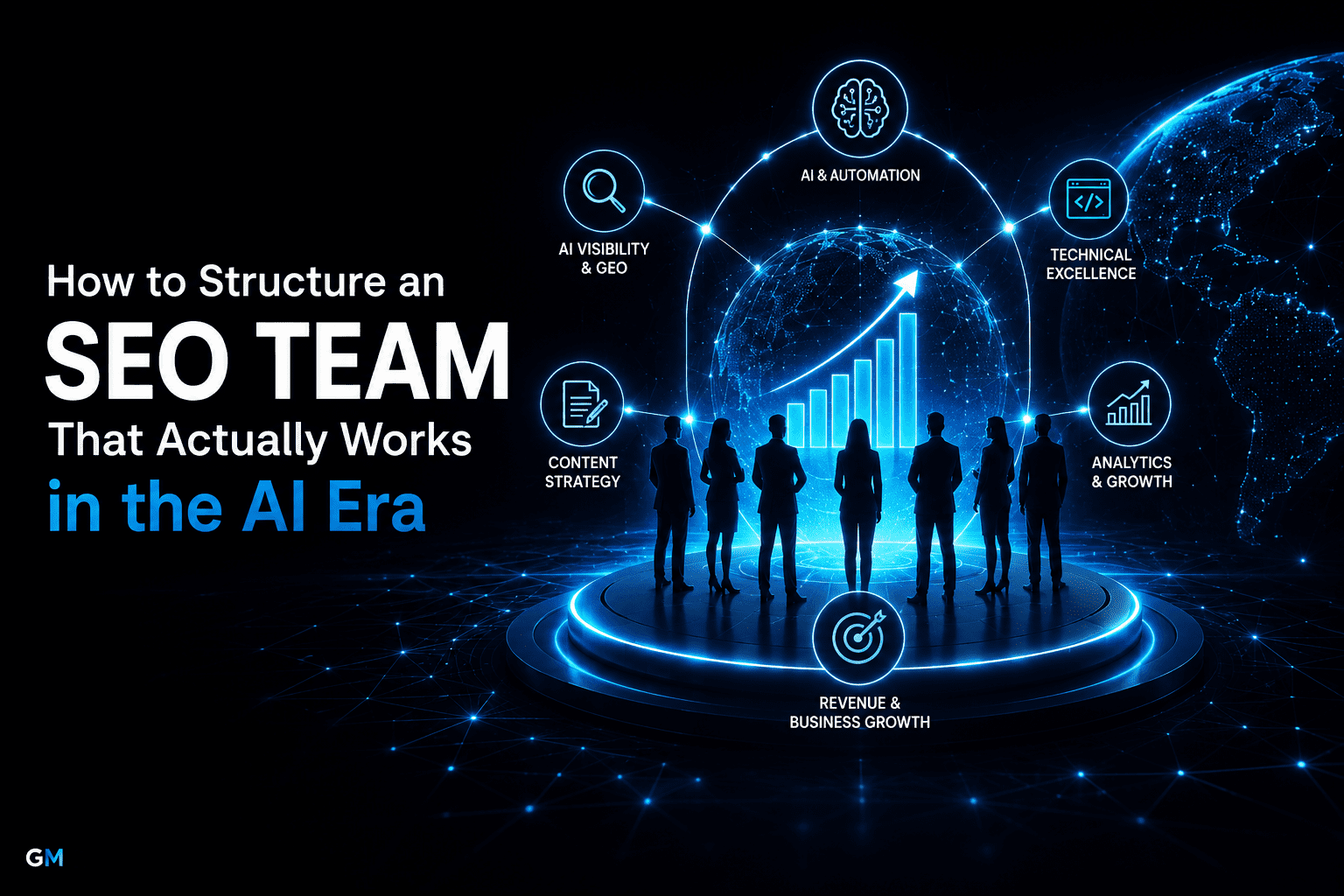
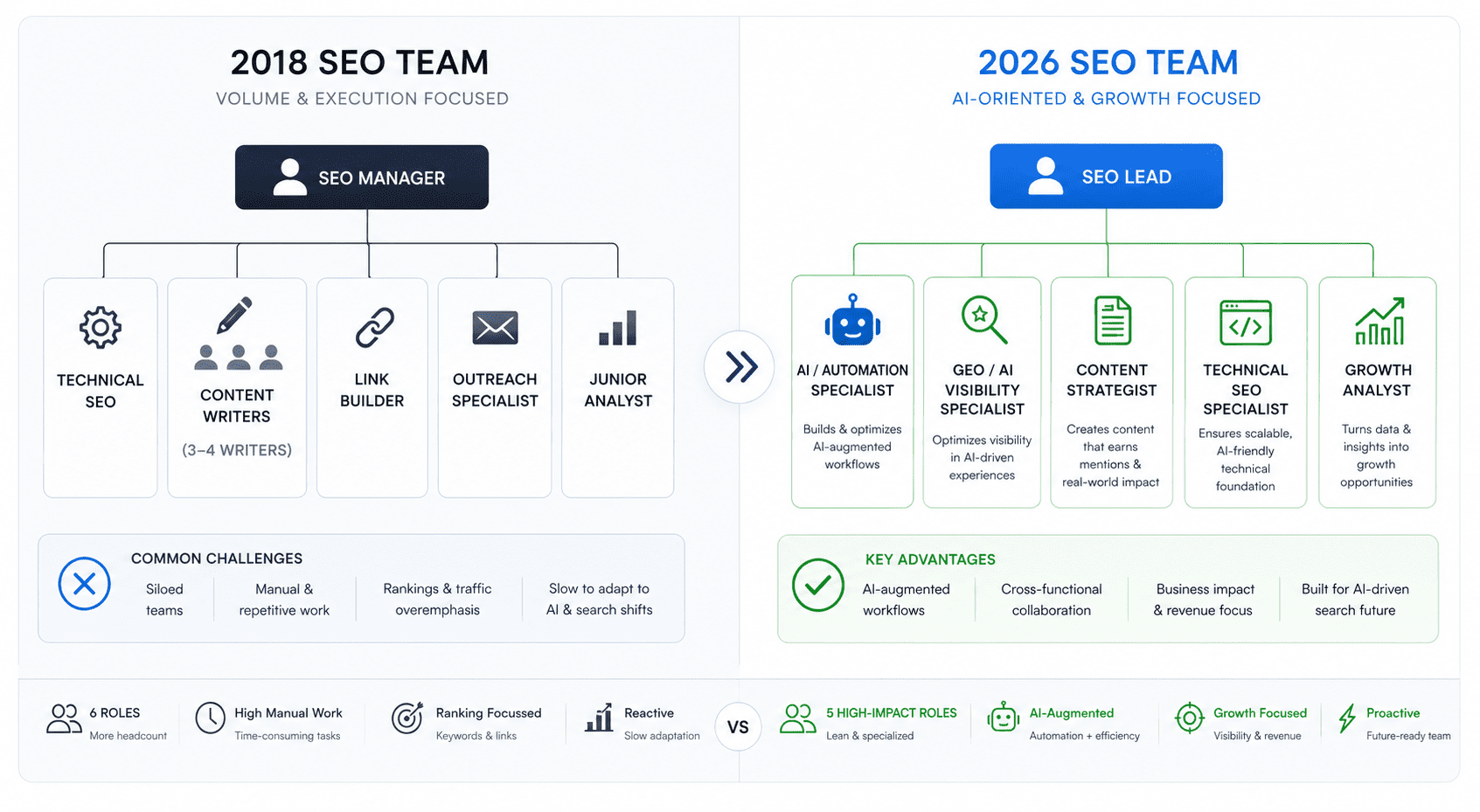
Most SEO team structures I see were built for 2018 work, not 2026 work. They’re heavy on content production and link building, light on automation and AI visibility, and they still measure themselves in rankings and impressions. The shape that works now is different on both axes: AI-oriented in how it operates, growth-minded in how it measures itself. The fix isn’t a bigger team. It’s a team built around those two ideas.
The operational shift is already visible across the agencies and in-house teams I talk to. The roles changed. The headcount math changed. The skill mix at the senior end changed.
The structural shift isn’t a guess. ALM Corp’s analysis of 3,900 SEO job listings in 2026 shows it plainly: junior headcount has flattened or fallen, senior pay has gone up, and entirely new role titles (GEO Specialist, AI Visibility Analyst, Search Intelligence) appear on a meaningful chunk of teams that didn’t have them two years ago.
The modern SEO team has two defining traits. It’s AI-oriented in how it operates: roles built around AI-augmented workflows for briefs, audits, schema, intent classification, and citation tracking. It’s growth-minded in how it measures itself: it reports in business outcomes (revenue, pipeline, AOV, retention) and integrates with paid, lifecycle, content, and brand instead of operating as a silo. Teams that only get one of those right plateau. Teams that get both run leaner and produce more.
What changed for SEO teams between 2018 and 2026
The work didn’t get smaller. It got more strategic per person.
AI Overviews and citation-based discovery shifted the goal from “rank for the keyword” to “be the source the AI cites.” That changed the day-to-day for most senior SEOs. Tracking citations across ChatGPT, Gemini, Perplexity, Copilot, and Google AI Mode is now a real workstream, not a side project.
Content briefs, schema generation, technical audit reports, and intent classification are all AI-augmented by default. Industry adoption data shows AI tool use hit 84% for content briefs and 71% for technical audits in 2026. That’s not a future scenario. That’s where the work already is.
Headcount has flattened or fallen at the junior tier because the production work that used to require five writers and three technical interns now runs through a different operating model. At the same time, director-and-above pay has gone up sharply because the people who can design the operating model are scarce.
A new sub-discipline called GEO/AEO (generative engine optimization, answer engine optimization) went from a rounding error to a named role on roughly 38% of teams in 24 months. That’s a fast curve. The teams that haven’t added the role yet are the ones losing visibility share to teams that have.
The roles that matter on a modern SEO team
These are the six roles I’d build a modern SEO team around. Not all of them exist on day one. They exist by the time the team has serious headcount.
SEO Lead or Head of SEO. Strategy, cross-functional coordination, stakeholder reporting. Senior, not entry-level. The role is less about tactical execution and more about deciding which parts of the operating model AI handles and which parts a human does. Industry salary data lands this role between $140K and $220K depending on company stage. Backlinko’s team-building writeup lays out the role expectations in depth, and Digital Applied’s 2026 SEO team statistics report anchors the headcount and budget numbers across company tiers.
AI / Automation Specialist. Owns the AI-augmented workflows. Builds the brief generation pipeline, the technical audit runner, the schema generator, the internal tooling that connects Screaming Frog, Ahrefs, GSC, GA4, and the model APIs. This role didn’t exist three years ago. It’s the second hire after the SEO Lead now, in many teams I’ve seen.
AI Visibility / GEO Specialist. Tracks brand visibility across AI platforms. Optimizes for citation in AI Overviews, ChatGPT answers, Perplexity sources, Gemini responses. Reports on citation share, not just rankings. This is the fastest-growing SEO sub-discipline in 2026, and teams with a dedicated GEO specialist are showing roughly 2.4x the AI citation rate of teams without one.
Technical SEO Specialist. Still needed. The role narrowed. The day-to-day is now architecture, schema review, performance edge cases, JavaScript rendering, and the technical work AI tools can’t fully resolve alone. Less crawl-and-fix, more design-and-debug.
Content Strategist. Decides what’s worth creating from a business perspective. Replaces the multiple content writer hires of the 2018 team. AI handles drafting and structural optimization; the strategist owns brand voice and decides which pieces are worth running through the pipeline in the first place. The job is editorial judgment plus cross-functional alignment with paid and lifecycle.
Analyst. Ties SEO KPIs to business outcomes. Builds the reporting that connects organic-driven revenue, assisted conversions, and AI Overview citation share back to the company’s growth metrics. Cross-functional by design. This role often sits between SEO and growth analytics rather than under SEO exclusively.
Team size by company stage
Headcount is leaner per dollar of ARR than it used to be. Industry data from 2026 lands the median in-house SEO team size at:
- $10M ARR: 1.4 full-time equivalents
- $50M ARR: 3.6 FTE
- $250M+ ARR: 9.8 FTE
- $1B+ ARR: 26.1 FTE
A few things stand out. The early-stage team is almost always one person. That person has to be senior. Trying to start with a junior SEO at sub-$20M ARR is a common mistake because the work at that stage is strategy and cross-functional coordination, not execution volume.
The mid-stage team (around $50M ARR with roughly 3-4 FTE) is the most common size and the one most likely to be structured wrong. The wrong shape at this stage is one SEO Lead plus two content writers and a junior analyst. The right shape is one SEO Lead, one AI / Automation Specialist, one Content Strategist, and one cross-functional Analyst. Same headcount. Different output.
Founders building their first SEO team should plan for one senior generalist before two specialists. The senior person will figure out which specialist to add second based on where the bottleneck actually is.
The growth mindset: why modern SEO teams think beyond rankings
The roles I described only work if the team thinks in business outcomes, not channel outcomes. SEO that reports rankings instead of revenue is a 2015 org design.
A growth-minded SEO team measures itself by organic-driven revenue or pipeline, assisted conversions where organic was a touchpoint, branded versus non-branded split as a demand-generation signal, and AI Overview citation share for the topics that matter. The vanity metrics stay in the internal weekly. They don’t go on the exec deck.
This is why modern SEO leads spend a significant portion of their week in shared planning with paid (for branded versus non-branded coordination), with lifecycle (for retention loop integration), and with content (for production pipeline design). The work overlaps because the goals overlap. If your SEO KPI is climbing while PPC efficiency is silently tanking, you’re not winning. You’re shifting the cost.
This is how a leaner team produces more. The same people are working on shared business problems instead of duplicating effort across silos. The SEO Lead and the growth marketer aren’t two separate stakeholders. They’re the same stakeholder with different titles.
Search Engine Journal’s piece on why most SEO teams still haven’t made the AI transition lands the same point from a different angle. The hard part isn’t adopting AI tools. The hard part is rethinking the mindset of the team around growth outcomes, which requires senior leadership and cross-functional buy-in.
If you’re looking at what SEO work actually looks like in 2026 across team setups, the freelancer and in-house picture is the same on this dimension. Growth-minded SEOs get hired. Channel-minded SEOs get cut.
How to hire in the right order
The order matters more than the speed. Hiring the wrong second role is the most common SEO team mistake I see.
Step 1: Hire the SEO Lead. Senior, generalist with depth in one area, cross-functional by background. This person should be able to write the KPI framework, design the operating model, and represent SEO in a quarterly business review. Don’t compromise on seniority here, even if it takes six months to find the right person.
Step 2: Hire the AI / Automation Specialist before the second content hire. This is the step most teams get wrong. The old playbook said “hire two content writers next.” The new playbook says: hire one person who can build the AI-augmented workflows that replace what those two writers used to do, plus a chunk of operational overhead on top. The math works out for the company and the work is more interesting for the AI specialist.
Step 3: Hire the Content Strategist, not the Content Writer. The strategist designs the editorial pipeline, decides what’s worth creating, owns brand voice, and works with the AI specialist on production. AI does most of the drafting. Humans own the strategy.
Step 4: Add the GEO/AEO Specialist when AI Overview citations become a top-three reporting metric. For most companies that’s already happening. For some it’s still 6 to 12 months out. Don’t pre-hire this role before the reporting demand is real.
Step 5: Add the Technical SEO Specialist when site complexity or product velocity demands it. Enterprise sites, JS-heavy products, and multi-region deployments need this role earlier. Smaller catalog sites can hold off.
Avoid: hiring two junior content writers before any of the above. That was the 2018 playbook, and it’s why most mid-stage SEO teams feel both overloaded and under-resourced.
Conductor’s enterprise SEO team structure guide covers the higher end of this hiring path well, and Traffic Think Tank’s breakdown of roles and hiring order is a useful reference for mid-market hiring. The framework I keep coming back to for any AI versus human decision in this process is the one I use to decide which work should be human versus AI before I add anyone or any tool to the team.
Final thoughts: AI-oriented, growth-minded, leaner
The team that wins in 2026 is AI-oriented in how it operates and growth-minded in how it measures itself.
AI-oriented teams that don’t have a growth mindset end up automating the wrong work and reporting the wrong metrics. The dashboard fills up with rankings that don’t tie to revenue, and the team looks productive in Slack but gets cut in the next budget review. Speed without direction is expensive.
A growth-minded team without AI orientation runs into a different ceiling. They know what to measure, but every new initiative requires another person to execute it manually. Headcount keeps growing, and eventually the math breaks.
The combination is what makes a six-person team out-produce a twelve-person one. Specialization at the senior end. AI augmentation through the middle of the operating model. Cross-functional integration with paid, lifecycle, content, and brand. A measurement system tied to actual business outcomes.
Don’t size the team. Shape it.
Find me on LinkedIn if you’re hiring or being hired into one of these roles and want to compare notes.
FAQ
What does “AI-oriented SEO team” actually mean in practice?
An AI-oriented SEO team builds AI-augmented workflows into the operating model from the start rather than treating AI as a sidecar tool. Content briefs, technical audits, schema generation, intent classification, and AI Overview citation tracking all run as pipelines, not as one-off tasks. A dedicated AI / Automation Specialist owns those pipelines. The team’s output per person goes up because the routine work is handled by the model and the humans focus on strategy, integration, and judgment calls.
What’s the ideal SEO team size for a $50M ARR company in 2026?
Industry data lands the median in-house SEO team at 3.6 FTE for $50M ARR companies. The right composition at that size is usually one SEO Lead, one AI / Automation Specialist, one Content Strategist, and one cross-functional Analyst. That’s the shape that produces results without growing headcount. Adding two more junior content writers instead is the most common structural mistake at this stage.
Should I hire a content writer or an AI specialist first for my SEO team?
Hire the AI / Automation Specialist first. The old playbook of “two content writers next” doesn’t survive the AI-augmented operating model. One AI specialist can build the brief generation, audit, and schema pipelines that replace what two content writer hires used to produce. The math works out better for the company and the work is more interesting for the specialist.
What is a GEO/AEO Specialist and why is the role growing so fast?
A GEO/AEO Specialist focuses on Generative Engine Optimization and Answer Engine Optimization. They track and optimize brand visibility across AI platforms (ChatGPT, Gemini, Perplexity, Copilot, Google AI Overviews, and Google AI Mode) and report on citation share for the topics that matter to the business. The role is on roughly 38% of SEO teams in 2026 and grew from near-zero in about 24 months. Teams with a dedicated GEO specialist are showing roughly 2.4x the AI citation rate of teams without one.
How should an SEO team operate with a growth mindset instead of a channel mindset?
A growth-minded SEO team measures itself by business outcomes (organic-driven revenue or pipeline, assisted conversions where organic was a touchpoint, branded versus non-branded split, AI Overview citation share) rather than channel-only metrics like rankings, impressions, or Domain Authority. It integrates with paid, lifecycle, content, and brand teams instead of operating in a silo. The SEO Lead and the growth marketer share the same KPIs. The same people are working on shared business problems, which is what lets a leaner team produce more.
Can a one-person SEO team work in 2026?
Yes, for early-stage companies and freelancers, a one-person SEO function is the most common setup. Industry data shows the median for $10M ARR companies is 1.4 FTE. The catch is that the person has to be senior. The work at that stage is strategy, operating model design, AI workflow setup, and cross-functional coordination with paid and content. A junior SEO at that stage is set up to fail because the work isn’t volume execution.
Sources & References
- ALM Corp’s analysis of 3,900 SEO job listings in 2026 — almcorp.com
- Backlinko’s team-building writeup — backlinko.com
- Digital Applied’s 2026 SEO team statistics report — digitalapplied.com
- Search Engine Journal’s piece on why most SEO teams still haven’t made the AI transition — searchenginejournal.com
- Conductor’s enterprise SEO team structure guide — conductor.com
- Traffic Think Tank’s breakdown of roles and hiring order — trafficthinktank.com