In the last 12 months, the entire SEO tool category shipped AI features at the same time. Ahrefs has Brand Radar for AI visibility and Agent A as an autonomous marketing agent. Semrush has the AI Visibility Toolkit. Surfer has Surfer AI. SearchAtlas has OTTO. SE Ranking has its own AI suite. Most of them cost between $40 and $700 a month on top of your existing SEO subscription, and most of them are not worth that markup.
Some of these features are genuinely useful, mostly the ones focused on AI visibility tracking. Most are demo-quality content wrappers around a GPT or Claude call. For any feature that’s just an LLM with a brand color, you can build the same thing yourself with Claude Code, the model APIs, or an MCP setup, without paying the AI premium. The scale of the AI rush is documented in numbers, and one industry roundup tracked 150+ data points on AI in SEO just for 2026.
AI Overviews reshaped what SEO means in the last 18 months. Tools had to ship AI features fast, and they did. The marketing budgets were louder than the engineering teams. So now every product page has an AI badge, and a freelancer or in-house team is being asked to pay $50 to $700 per month per tool to keep up. One practitioner tested 20+ AI SEO tools and graded them honestly, and the conclusions are not flattering for most of the category. This is where I draw the line between what’s worth buying and what’s worth building.
The state of AI in SEO tools
Every tool I use day-to-day shipped an AI feature in the last 12 months. Most shipped multiple. Ahrefs split AI into two products, Semrush bundled it into a separate toolkit, Surfer added an AI writer on top of Content Editor, SearchAtlas built an autonomous agent called OTTO, and SE Ranking quietly added AI to its Content Marketing module without raising prices much.
The pattern is hard to miss. AI Overviews disrupted Search. Every tool that depends on Search had to ship something or look obsolete. Most shipped fast, which means a lot of these features are GPT or Claude wrappers in a different UI.
Real workflow gains are concentrated in a small handful of features. The rest is product page material.
The three things AI in SEO tools is trying to do
There are basically three categories of AI features in SEO tools right now. Each one has a different success rate.
AI visibility tracking is a real need. AI Overviews, ChatGPT, Perplexity, Gemini, Copilot, and now Google AI Mode all cite sources, and SEOs need to know if they’re being cited. The data isn’t trivial to collect. Implementations are getting better quickly. Ahrefs Brand Radar, Semrush AI Visibility Toolkit, SE Ranking’s AI Visibility Tracker, and SEOmonitor all play here, and the best of them produce data you can actually act on.
AI content generation is mostly hype. Surfer AI, Frase, Writesonic, SE Ranking’s Content Editor, and a dozen smaller tools all promise to draft content that ranks. In my experience the edit cycle on AI-generated copy is roughly the same as writing from a brief. Sometimes longer. Useful for outlines and skeletons, painful as a finished product.
AI automation, or autonomous SEO agents, is the newest category and the most interesting. SearchAtlas OTTO pitches itself as actually deploying changes to your site instead of recommending them. Ahrefs Agent A connects to your data and runs autonomous workflows for cannibalization detection, content calendar work, competitor analysis, and link strategy. Different products, different risk profiles, both worth watching closely. Google’s own documentation of AI features in Search is the baseline for understanding what these tools are trying to win against.
Tool by tool, my honest take
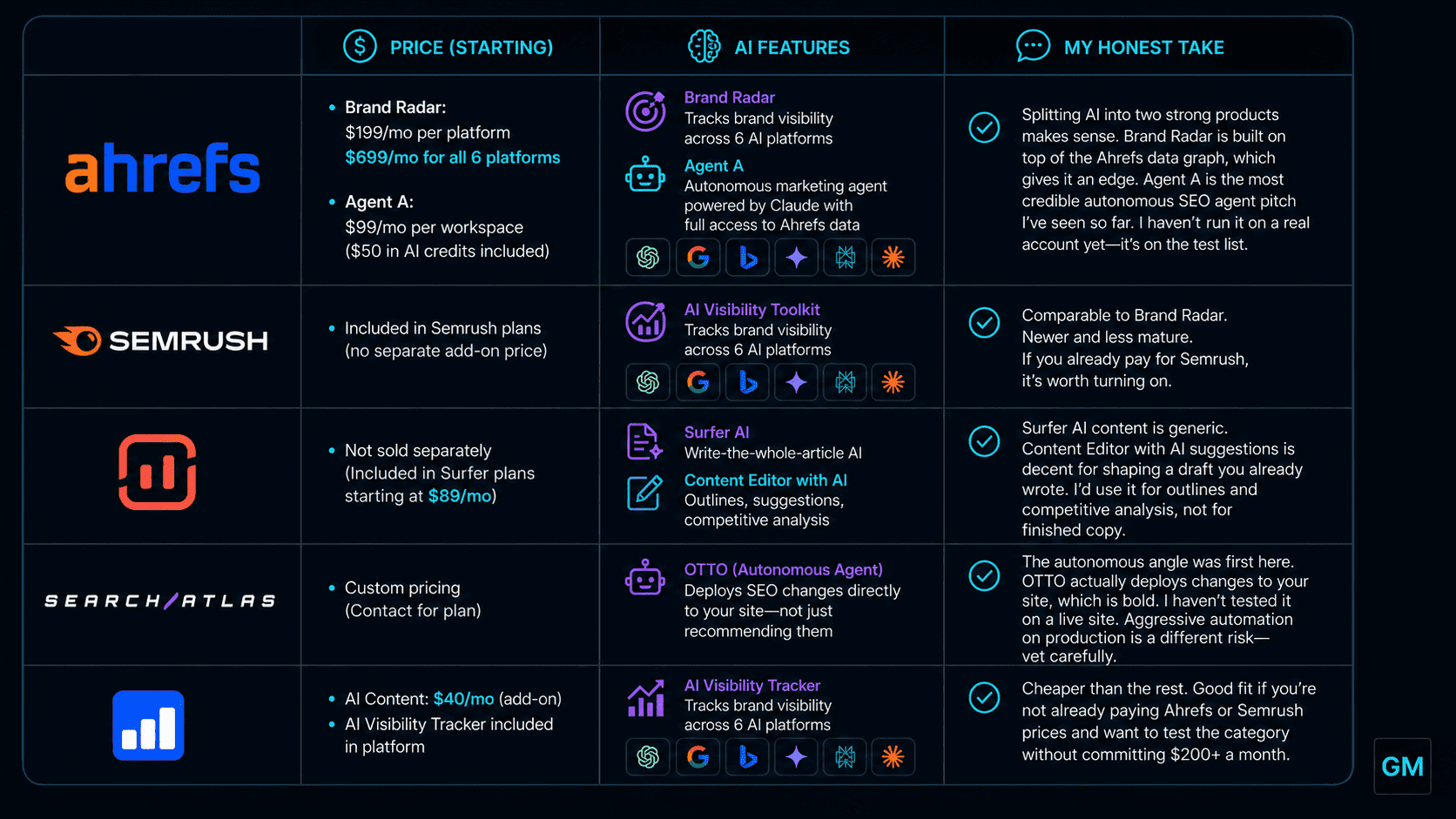
Ahrefs (Brand Radar + Agent A). Ahrefs split AI into two products, and both are worth a serious look. Brand Radar tracks brand visibility across 6 AI platforms ($199/mo per platform, $699/mo for all 6). Agent A is their autonomous marketing agent ($99/mo per workspace with $50 in AI credits included, runs on Claude). Brand Radar sits on top of the existing Ahrefs data graph, which is what makes it useful in practice. Agent A is the most credible autonomous SEO agent pitch I’ve seen so far, mainly because it has unrestricted access to actual Ahrefs metrics rather than running on a wrapper. I haven’t run Agent A on a real account yet. It’s on the test list.
Semrush AI Visibility Toolkit. Comparable to Brand Radar. Newer, less mature. Same use case. If you already pay for Semrush, it’s worth turning on. If you don’t, Ahrefs is the more polished entry point.
Surfer AI / Surfer Content Editor. Surfer AI as a write-the-whole-article tool produces generic output. Content Editor with AI suggestions is decent for shaping a draft you already wrote. I’d use it for outlines and competitive analysis, not for finished copy.
SearchAtlas / OTTO. The autonomous angle was first here. OTTO actually deploys changes directly to your site instead of just recommending them, which is bold positioning. I have not tested it on a live site. Aggressive automation on a production site is a different risk profile than a content tool, and I’d want to vet it carefully before letting it touch a client property.
SE Ranking AI suite. Cheaper than the rest, with the AI content module sitting at $40/mo as an add-on. AI Visibility Tracker covers the same six platforms as the bigger tools. Good fit if you’re not already paying Ahrefs or Semrush prices and want to test the category without committing $200+ a month.
Frase, Writesonic, and the smaller AI content tools. All in the content generation lane. Edit cycles longer than starting from a brief. Skip unless you have a specific use case that fits.
The price problem
Add up the AI features I just listed. If a freelancer wanted access to Ahrefs Brand Radar all-platforms, Surfer AI, Frase, SearchAtlas Pro, and SE Ranking’s content add-on, you’re looking at roughly $1,200 to $1,500 per month. That’s before the base subscriptions to the tools that surround them.
The math doesn’t work for most freelancers or small in-house teams. Even agencies running multiple clients run out of budget if they try to keep every AI feature subscribed. The honest review where the results pissed the reviewer off gets at the same problem. A lot of these features overlap, a lot of them deliver thin value, and the cumulative bill is bigger than the incremental result.
Before adding any AI feature to the stack, run the build-versus-buy question. The framework I use to decide if AI is the right call helps clarify whether the gap a tool is filling needs a vendor subscription or an afternoon of building.
The DIY alternative: Claude Code, Codex, model APIs, MCPs
Most AI in SEO tools is GPT or Claude under the hood. You can call those models directly for cents per audit. The markup the tools charge is for the wrapper, the dashboard, and the brand familiarity. Sometimes that’s worth paying for. Often it isn’t.
Claude Code builds the workflow around the model. I’ve used it to write Python scripts that pull a Screaming Frog crawl, send each page’s content through a local embedding model, cluster the results, and flag semantically similar pages. That entire pipeline replaces what Ahrefs Brand Radar’s methodology describes for semantic clustering, at zero ongoing cost beyond compute. Codex does the same on the OpenAI side. The model isn’t the hard part. Knowing what to ask it to build is the hard part.
MCPs, or Model Context Protocol servers, are the missing piece. They let you connect Screaming Frog, Ahrefs, GSC, and your own scripts to an AI agent without an enterprise integration team. I’ve connected my own GSC and GA4 OAuth setup to Claude this way for weekly reporting. The marginal cost is API tokens. The marginal effort, once you’ve done it once, is small.
I built my own tooling this way. The topical authority map tool I built does semantic clustering, cannibalization detection, and coverage gap analysis using local embeddings. It overlaps with what Brand Radar and SearchAtlas OTTO charge $200+ per month for. It cost me a weekend and ongoing API credits in cents.
I’m not the only person doing this. Freddie Chatt ran a similar test and landed in a similar place, which is that most of these tools don’t beat a well-built custom workflow on cost-per-insight.
Final thoughts
AI is everywhere in SEO tools. The bill doesn’t have to be.
Pay for what genuinely fixes a workflow problem you’ve actually had. Build the rest. The tools worth their AI premium right now are the ones with real data depth behind them, mainly the AI visibility trackers from Ahrefs and Semrush. Most of the rest is content generation in a fresh coat of paint, and you can build that yourself in less time than it takes to evaluate the tool.
The freelancers and in-house teams who win this cycle will be the ones who can tell a feature from a wrapper.
Find me on LinkedIn if you want to compare notes on what’s actually working for you.
FAQ
Which AI SEO tool is actually worth paying for in 2026?
If you have to pick one, Ahrefs Brand Radar is the most useful right now, mainly because it sits on top of Ahrefs’ existing data graph. Semrush’s AI Visibility Toolkit is comparable if you’re already on Semrush. The AI visibility category is where vendors are delivering real value. Most content generation tools are not worth a separate line item.
What is Ahrefs Agent A and how is it different from Brand Radar?
Agent A is Ahrefs’ autonomous marketing agent. It costs $99/month per workspace with $50 in AI credits included and runs on Claude. Brand Radar is a tracking and reporting tool for AI visibility across six platforms. Agent A is a workflow tool that runs autonomous tasks like cannibalization detection, content calendar generation, and competitor analysis. Different use cases, different price points, both from Ahrefs.
Do AI content generation tools like Surfer AI or Frase produce work that ranks?
In my experience, no. The output is usable as a draft skeleton but requires roughly the same edit time as writing from a brief. For finished content that competes in 2026 SERPs, AI-generated copy needs heavy human editing. Useful for research and outlines. Not for shipping.
What’s the difference between AI SEO tools and AI Visibility tracking tools?
AI SEO tools is a broad category that includes content generation, on-page optimization, keyword research, and technical SEO with AI features bolted in. AI Visibility tracking is a more specific subcategory focused on monitoring whether your brand is being cited in AI-generated answers from ChatGPT, Gemini, Perplexity, Copilot, and Google AI Overviews. Most major SEO tools now offer both, but they’re distinct workflows.
Can you build your own AI SEO tools with Claude Code or model APIs?
Yes. Most of what AI SEO tools do is a wrapper around the same model APIs you can call directly. Claude Code lets you build the workflow around the model. Sentence-transformers handles local embeddings for free. MCPs connect your existing tools to an AI agent. The trade-off is engineering effort upfront for ongoing cost savings and a workflow that exactly fits your needs.
Which AI SEO tool should a beginner or solo freelancer start with?
If you’re starting from scratch, SE Ranking’s AI suite is the cheapest entry point at around $40/month for AI content and a few hundred AI Visibility checks. If you already have Ahrefs or Semrush, turn on their AI features before paying for a separate tool. Avoid stacking multiple AI content generation tools. They overlap heavily and the budget doesn’t go far.
Sources & References
- one industry roundup tracked 150+ data points on AI in SEO — position.digital
- One practitioner tested 20+ AI SEO tools and graded them honestly — behindrankings.com
- Google’s own documentation of AI features in Search — developers.google.com
- Agent A is the most credible autonomous SEO agent pitch I’ve seen so far — ahrefs.com
- OTTO actually deploys changes directly to your site — searchatlas.com
- The honest review where the results pissed the reviewer off — onfolio.com
- Freddie Chatt ran a similar test and landed in a similar place — freddiechatt.com